Я попробовал ноутбук HP RTX Spark и потратил 50 миллионов токенов искусственного интеллекта – и это обошлось мне в 0 долларов
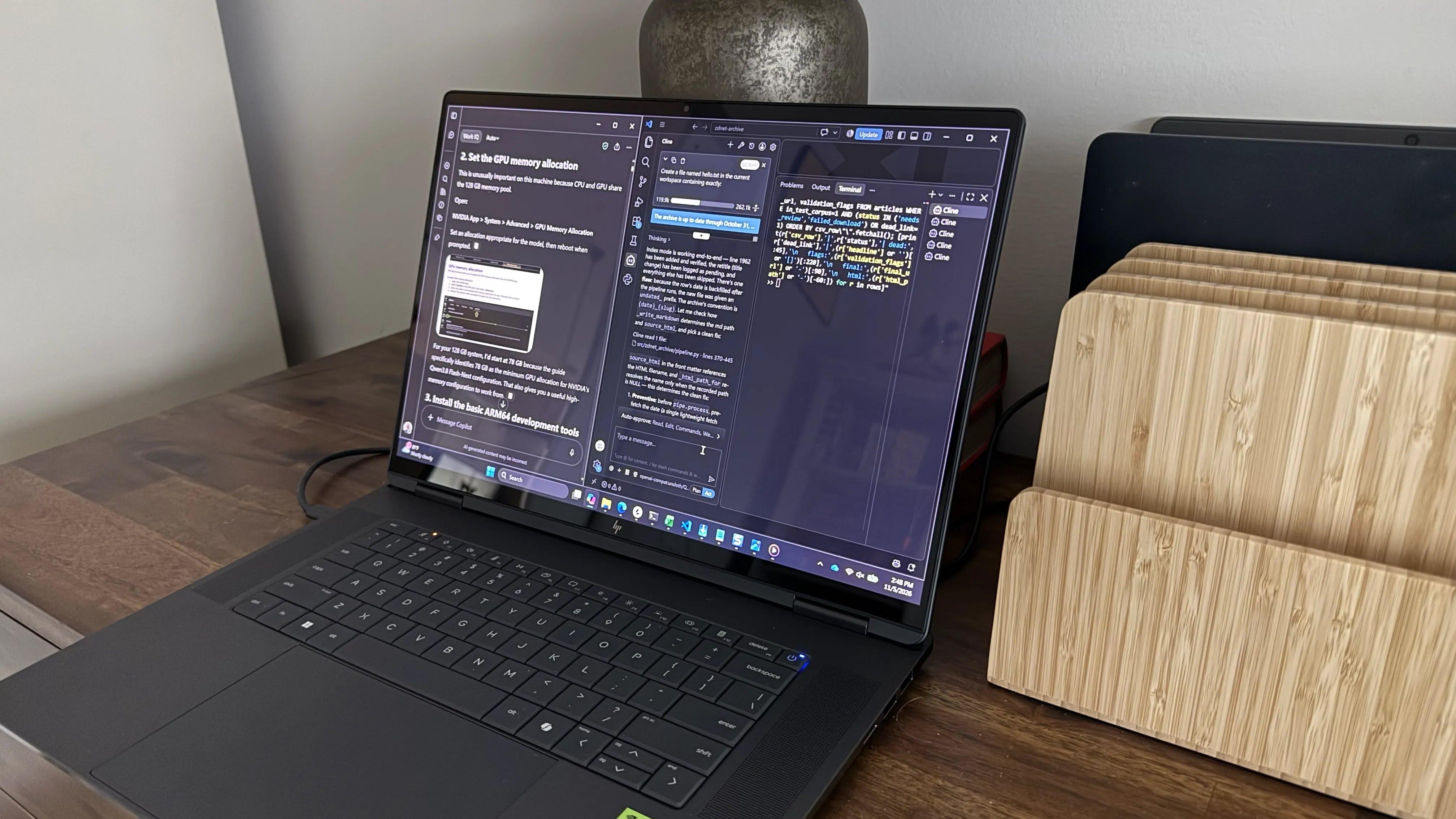
- Компьютеры, построенные на архитектуре Nvidia RTX Spark, превосходно справляются с задачами искусственного интеллекта.
- При использовании локальной модели с открытыми весами не взимается плата за токены и не устанавливаются ограничения на использование.
- Самым большим преимуществом использования локальной модели с искусственным интеллектом является конфиденциальность.
Еще на заре компьютерной эры легендарный редактор журнала PC Magazine Билл Мачроун сформулировал закон Мачроуна: "Машина, которую вы хотите, всегда будет стоить около 5000 долларов". Возможно, сегодня это число немного выше из-за текущего кризиса с оперативной памятью, но с поправкой на инфляцию закон Махрона по-прежнему остается в силе. Доказательство? Прямо сейчас у меня на столе стоит ноутбук стоимостью 7000 долларов, и я должен признаться, что мне очень-очень этого хочется.
Также: Я провел для ноутбука Lenovo RTX Spark совершенно безумный тест на программирование с помощью искусственного интеллекта – и он прошел его успешно
HP OmniBook Ultra - настоящий зверь. Он оснащен RTX Spark от Nvidia, 128 ГБ встроенной памяти, 2 ТБ быстрой памяти Gen5 NVMe и великолепным 16-дюймовым OLED-дисплеем. Он весит почти пять фунтов, но на самом деле это не столько портативный ПК, сколько персональный центр обработки данных, обеспечивающий производительность искусственного интеллекта FP4 в 1 петафлопс.
I am not the target market for this PC. But after using it for a few weeks, I am seriously tempted. For AI-related work, its GPU has many times the power of a garden-variety Copilot+ PC, and it’s able to take full advantage of the unified memory.
How local AI raced through my projectOne reason my project completed so quickly was that I was able to run it uninterrupted. I used Copilot to help me set up the working environment initially, using the open-source llama.cpp inference runtime, the open-weights Qwen3.8-27B large language model, and a coding harness called Cline, running as an extension in Visual Studio Code. With a little extra help from Copilot, I configured those tools, wrote a detailed spec for the app I wanted, fed it to Cline, and then mostly stood back and watched.
I had a good general idea of what all those components were doing, but it would have taken me weeks of reading, studying, and trial-and-error manual installation to get everything set up and running. Using the PowerShell scripts that Copilot wrote, I had the project under way within a half-hour.
As the project ran, I got to watch the AI "reason" in real time. Every so often it asked me to approve something, but mostly it wrote code, ran tests, observed the results, modified the code, ran some more tests, and so on. The whole process was a textbook example of "human-in-the-loop agentic coding," and all I had to do was check in every so often to see how things were going.
I knew it was busy, because when the LLM was working, I could hear the fan spinning from across the room. Surprisingly, the machine never got uncomfortably hot; still, this is the sort of work that’s best done with the laptop sitting on a desktop, not in a lap.
Also: I can access my home PCs remotely for free – how you can too (no VPN needed)
I gave the LLM a spreadsheet filled with links to my articles, which I had painstakingly built over the past two years. Not only did it find and retrieve nearly every article in that list, it built a separate routine to retrieve pages from the Internet Archive’s Wayback Machine for roughly 90 links that returned 404 errors, and then presented me with a list of another 90 or so pages it couldn’t retrieve at all. It took maybe 30 minutes to review and resolve that last set of issues.
After all was said and done, I had two folders, each containing 1,951 files — one set in raw HTML, the second in Markdown format. And to wrap up, I had my local AI build a simple script that I can run to add new posts to the archive as they’re published.
I cannot begin to tell you how happy this result made me.
How much did it cost?The complete project used 479 LLM inference calls and processed nearly 50 million logical tokens, at a total net cost of exactly $0.00.
One of the most frustrating aspects of using these modern AI coding harnesses is that there’s no way to estimate how many tokens they’ll use.
I could have used a commercial AI subscription to do this job, but I would have been flying blind. None of the companies that sell those plans can tell you how much a given project will cost. Your actual consumption — and thus the final bill — depends on factors you can’t know in advance. How much code does the agent need to keep in context? How many iterations and debugging cycles will it require? Which models will you use?
Also: Is Claude Code truly faster with message threads? I did the math on my logs
ChatGPT Plus (with Codex), Claude Code Pro, or GitHub Copilot all cost between $10 and $20 per month. That’s more than enough for a simple task, but for this project, I would have quickly slammed into usage limits with those entry-level plans. To keep working with a $20-a-month plan, I would have had to take frequent breaks, or buy extra credits, or upgrade to a $100-per-month plan with higher usage limits, like ChatGPT Pro, Claude Code Max, or GitHub Copilot Max.
After staring at those numbers, I got a sense of where Anthropic, OpenAI, and Microsoft’s business models are going. Even at $100 a month, if I decided to run some even more ambitious projects, I could have easily found myself rate-limited, with work having to wait for hours or days until the next cycle began.
For serious coders, those bills can get very pricey. On a recent episode of Nilay Patel’s Decoder podcast, analyst Joey Brookhart offered a startling statistic: "The top 5 percent of Claude Code users are spending $18,000 a year on average. Non-Claude Code users spend well under $75 a month."
Now I know why.
The biggest benefit of allUsing a free, open-weights model with an open-source coding harness gives you the freedom to experiment without worrying about the bill. But that’s only part of the story. The much bigger benefit is that you’re not sending potentially sensitive or confidential data to someone else’s cloud; with a fully local AI stack, your prompts, documents, and inference workloads don’t have to leave the PC at all.
That wasn’t a big deal for my project, which used content that had already been published to the web. But I have a couple other apps in mind that I’d rather not share with anyone else until they’re ready. One involves a big stack of financial documents, credit card statements, and invoices. I’m happy to feed that data into an LLM on my own PC, but I’m not comfortable uploading those documents to a cloud-hosted coding service.
Also: This free Windows tool is my secret weapon for setting up new PCs
Will I do enough of this kind of work to justify spending $7,000 on a PC? I’d love to say yes, but my CPA would just stare at me for a full minute and then patiently explain how "return on investment" works. "No, Ed, you can’t justify this expenditure."
The good news is that Machrone’s Law works hand in hand with Moore’s Law, which describes a reliable technology trend: computing power doubles every 18 months or so. That means in another three years I’ll be able to drool over a PC with four times this much computing power for $7,000. But by that time a configuration like this HP OmniBook Ultra will probably be a mainstream business-class machine, available for a fraction of its current price.
Until then, I’ll wait.
>