Дорожная карта "Беспроводной энергетический интернет" показывает путь к свету, теплу и движению без батарей
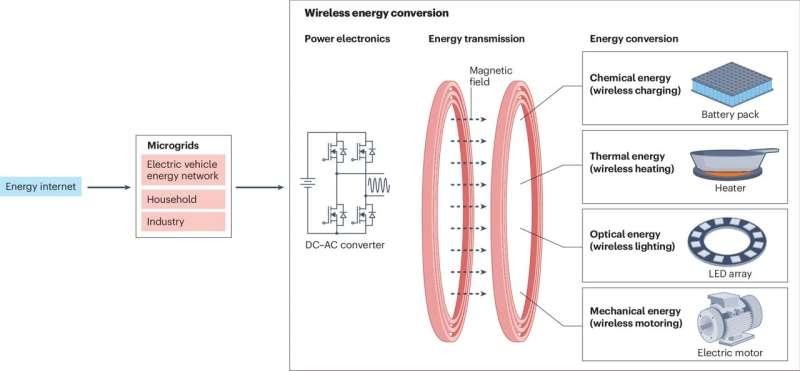
Беспроводная зарядка уже изменила способы подзарядки телефонов, носимых устройств и даже электромобилей. Следующий шаг заключается в развитии беспроводных технологий, которые позволят перейти от подачи электрической энергии к прямому производству неэлектрической продукции, такой как оптическая, тепловая и механическая энергия, в соответствии с реальными потребностями. Это позволило бы создать сеть энергоснабжения, такую же гибкую и эффективную, как Интернет.
Чтобы ускорить эту трансформацию, исследователи из Гонконгского политехнического университета (PolyU) провели исследование, в котором изложена техническая схема "беспроводного энергетического интернета", направляющая отрасль от "беспроводной передачи энергии" к прямому "беспроводному преобразованию энергии".
Работа опубликована в журнале Nature Reviews Electrical Engineering.
Прямое преобразование позволяет избежать накопления энергии в аккумуляторах.Обычные беспроводные системы передачи энергии обычно получают электрическую энергию и накапливают ее в аккумуляторе или суперконденсаторе, прежде чем производить свет, тепло или движение.
Напротив, прямое беспроводное преобразование энергии преобразует передаваемую электроэнергию непосредственно в химическую, оптическую, тепловую или механическую энергию. Другими словами, энергия, передаваемая от передатчика, может преобразоваться в свет для освещения, тепло для обогрева или силу для приведения в движение — без предварительной зарядки аккумулятора — тем самым устраняются промежуточные этапы накопления и преобразования, снижаются потери энергии, повышается общая эффективность и упрощается аппаратное обеспечение приемника.
Исследование также устанавливает единую структуру, которая объединяет передачу данных в ближней и дальней зоне с различными приложениями, такими как беспроводная зарядка, освещение, отопление и управление автомобилем (механическая энергия), а также обобщает общие принципы проектирования и будущие направления развития базовых технологий.
Исследованием руководил Чау Квок Тонг, профессор кафедры электроэнергетики факультета электротехники и электроники и содиректор Исследовательского центра электромобилей (RCEV), совместно с Лю Вэем, доцентом того же факультета и менеджером RCEV в PolyU.
Разработайте пути коммерциализацииИсследовательская группа определила общие технические принципы и ключевые инженерные проблемы беспроводных систем преобразования энергии и предложила направления развития в таких областях, как стандартизация, кибербезопасность, сбор энергии и новые приложения. В нем также были изложены проблемы, которые необходимо преодолеть, и даны рекомендации для будущего крупномасштабного развертывания.
Their study received a Gold Medal with Congratulations of the Jury at the 50th International Exhibition of Inventions Geneva in Switzerland and a Grand Prize and a Gold Medal at the fourth Asia Exhibition of Innovations and Inventions Hong Kong.
Chau said, "Our review delivers impacts on two levels: first, it establishes practical design routes covering core technologies such as primary-side control, multi-frequency compensation networks, secure transmission and field-directed transmission; and second, it provides strategic guidance on future industry standards, security and application priorities.
"This will help industry select viable product architectures while enabling policymakers and investors to identify the infrastructure required to drive commercialization and mass adoption."
Less onboard storage, more specialized applicationsAt present, transferring electricity to batteries is the most mature and widely adopted energy transmission and storage technology. It is already used in portable electronics and biomedical implants and is developing rapidly in electric vehicles and rail transit.
By comparison, wireless lighting, heating and motoring demonstrate unique value in specialized applications, such as sealed motors for harsh environments, mobile robots that require less onboard storage and capacitive ultrasonic motors for magnetic-resonance-compatible robots. In these scenarios, conventional cables, batteries or receiver electronics are hard to maintain or undesirable. These systems can also offer lightweight designs, convenience, high efficiency, flexibility and improved safety.
At the consumer level, batteries can fail due to cell defects, internal short circuits, overcharging or poor thermal management, posing safety risks.
In contrast, wireless power operates more flexibly and sustainably and holds the potential to reduce battery-pack sizes or eliminate the need for onboard storage in vehicles. The smaller the battery and the less chemical energy stored, the lower the associated energy-storage risks—the most direct significance of wireless energy conversion for everyday life.
Transmission safety and standards remain hurdlesHowever, while direct conversion can ease energy-storage risks, it introduces a different safety consideration. Wireless energy networks still face a number of challenges, foremost among them the safety of energy transmission itself.
The potential effects of prolonged human exposure to electromagnetic fields and electromagnetic interference with nearby electronic devices are of particular concern in environments such as public spaces and medical facilities. The study also notes that system complexity and performance limitations, especially in high-power wireless charging and wireless motoring, constitute barriers to application.
Liu added, "Our study highlights a key commercialization challenge: most existing standards cover only specific applications, particularly wireless electric-vehicle charging. Comprehensive safety, emission and interoperability frameworks across broader wireless energy conversion remain incomplete.
"We therefore advocate designing wireless energy systems in a systematic and holistic manner, rather than optimizing individual energy conversion stages in isolation."
Networks that adapt to devices' energy needsThe research team classifies wireless energy conversion into four categories: chemical for charging, optical for lighting, thermal for heating and mechanical for motoring. Together, these four categories encompass most applications spanning homes, industry and biomedical use, as well as extreme environments such as deep-sea and deep-space exploration.
Looking ahead, a wireless energy network could automatically recognize the specific energy needs of different devices—whether chemical, optical, thermal or mechanical—and dynamically adjust transmission frequency, field distribution and power level accordingly.
The study also identifies four major engineering challenges—safety, scalability, complexity and performance—and, in response, outlines four priority directions for development. First, standard interfaces should be developed to enable devices to negotiate power, identify receivers, exchange data, control systems, handle faults and interoperate. Second, energy encryption should progress toward integrated physical-layer security.
Third, for aerospace applications, lightweight, sealed and radiation-tolerant couplers, converters and relay transmitters should be developed to connect satellites, stations, rovers and planetary bases. Fourth, electromagnetic harvesting should be strengthened, focusing on sensitive receivers, ultra-low-power rectification and hybrid architectures combining ambient energy harvesting with dedicated wireless power.
>