Крошечные дефекты в стекловолокне могут помочь выявить подводные кабельные угрозы
В начале августа два подводных кабеля у берегов Австралии, Индиго Уэст и Индиго Сентрал, вышли из строя с разницей в несколько часов. Что стало причиной двух отключений, до сих пор неясно. Появляющаяся технология, позволяющая кабелю заранее распознавать угрозы, может помочь точно определить причину и местоположение подобных сбоев в работе кабеля в будущем.
Согласно недавнему отчету Международного союза электросвязи, на подводных кабелях происходит от 150 до 200 аварий в год, при этом основными причинами отключений являются рыбалка и постановка на якорь. Новая функция обнаружения кабеля может превратить то, что сегодня является недельной игрой в угадайку, в диагностику в режиме реального времени, позволяя властям выдавать предупреждения еще до того, как произойдет отключение кабеля. Технология также может решить проблему ограниченного доступа к надежным и стандартизированным данным об авариях на кабелях и их причинах.
Кабели Indigo West и Indigo Central проходят в городе Перт, где с 2007 года запрещено ставить якоря внутри специально отведенной полосы для защиты подводных кабелей. Компания Subco, оператор кабельных линий, сообщила о "подозрительной" активности судна примерно во время отключения, хотя оператор заявил, что не будет знать наверняка причину сбоев до тех пор, пока не завершится фаза ремонта и восстановления.
На сегодняшний день существует ограниченное количество технологий оптоволоконного зондирования, способных обнаруживать неисправности кабеля на протяжении 200 километров, которые называются распределенным акустическим зондированием (DAS).
Однако на дальнемагистральных кабелях, таких как Indigo West и Indigo Central, любой участок кабеля с поддержкой DAS посреди океана - ни на первых, ни на последних 200 км любой оптоволоконной линии - сегодня по—прежнему не способен распознать какие—либо надвигающиеся опасности. Таким образом, для длинных трансокеанских кабелей, часто протяженностью от 6000 до 20 000 км, DAS в том виде, в каком она существует сегодня, недостаточна для обнаружения большинства возможных отключений по всей длине кабеля.
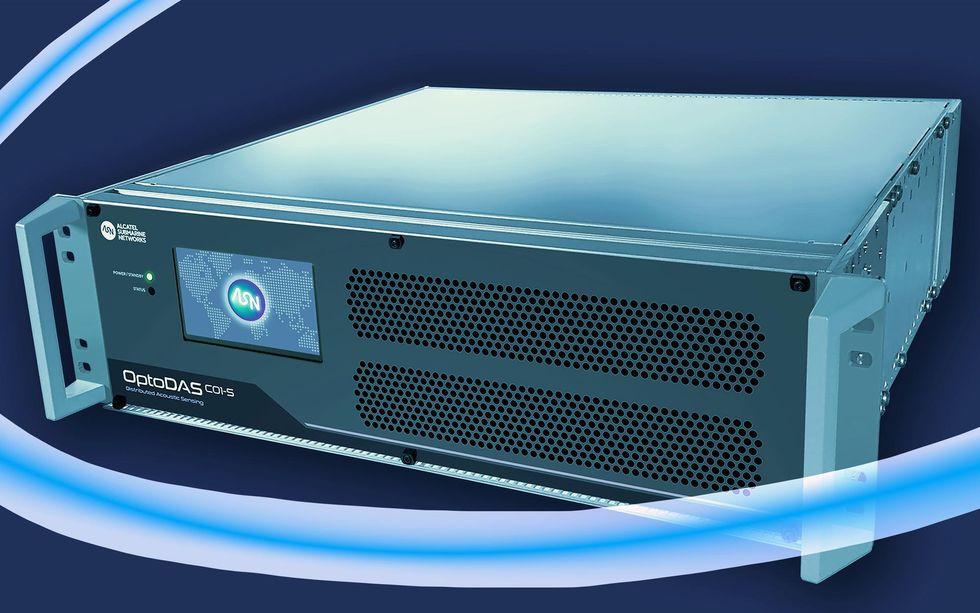
К счастью, французская компания Alcatel Submarine Networks (ASN), базирующаяся в Ле-Улисе, заявляет, что близка к запуску обновления своей системы DAS, которая расширит возможности технологии сверхчувствительности по всей длине трансокеанской оптоволоконной линии.
Как работает распределенное акустическое зондирование?Блок запроса DAS на обоих концахtransoceanic cable, installed at the cable’s landing point, sends laser light down the fiber and reads faint echoes that come back because of flaws in the glass, originating from the cooling process during the fiber’s manufacturing.
A tiny fraction of laser light traveling down the cable reflects off those flaws. DAS exploits this property (called Rayleigh backscattering), in which each cable behaves a little like an extended succession of tiny mirrors along the cable’s entire length—where each tiny mirror lets nearly the entire signal pass by, but occasionally reflects a small portion back toward the laser that sent it.
"The system works like an optical interferometer" says Jan Kristoffer Brenne, R&D manager for fiber sensing at ASN, "measuring how the phase of the returning light changes at each point along the cable."
When an anchor or piece of trawl gear drags across the seabed, it sends vibrations through the seabed floor. Those vibrations stretch the fiber optic cable a little bit, subtly shifting the phase of the signals inside the line. Of course, if an anchor or trawl gear ever actually strikes or drags a cable, more substantial phase shifts along the line can pick that up too.
DAS interrogator boxes on shore can detect these phase shifts and issue a warning up to 15 minutes and 2 km before an anchor or trawl gear even reaches the cable.
The new DAS technology, extending sensing capabilities across an entire cable’s span, introduces new hardware components to onshore operations for the line. Instead of one interrogator box covering each end of the cable, ASN’s upgraded system runs multiple interrogators at once at the landing station, each one tuned in to a different wavelength.
The technology underlying the new, enhanced DAS—called wavelength-division multiplexing, a popular throughput-increasing technique also used in 4G and 5G telecom—is in fact already in use for every cable’s repeaters. But now enhanced DAS also relies on the same multiplexing trick, but for the Rayleigh backscattered reflections not just the primary signals.
Installing DAS on an existing cable is quick, Brenne says, typically requiring a few hours of work at the landing station. And installation doesn’t even require shutting down the cable. Shutting down single fibers at a time are all that’s required to set up the enhanced DAS hardware.
"We don’t put anything new in terms of new equipment inside the repeaters," Brenne says. "But we adjust a feature inside [the repeater] in a way that supports cable threat monitoring on long-haul cable."
What Challenges Lie Ahead for DAS?Signal strength is today the main hurdle to developing enhanced DAS that senses outages across the entire length of a transoceanic cable. Each echo from each tiny flaw in the fiber line is itself extremely faint, millions of times weaker than the main signals the fibers carry. But also, every repeater that amplifies each echo also adds in a little noise that, over multiple repeaters, can drown out the original echo.
Even despite these complications, enhancing DAS sensing across the entire length of a cable is still worth pursuing, because outages in transoceanic cable lines are prohobitively expensive and time-consuming to fix.
"There’s a shortage in the repair ship industry generally with only 20 to 25 ships worldwide dedicated to [subsea cable] repairs," said Sandra Maximiano, chairwoman of ANACOM, Portugal’s telecommunications regulator. Brenne says a single repair to a cable line costs about 20 times more than a DAS unit.
Enhanced DAS could also increase the time and accuracy of warnings, which could help answer the question of responsibility in the case of damage to the line. The ITU subsea cables report notes that pairing DAS with ship-tracking data can identify a vessel near a cable. However, the report added that linking inferred seabed activity to a specific ship in the open ocean "remains challenging."
When four cables off West Africa were cut in March 2024, Nigeria’s communications minister, Bosun Tijani, had no clear answer to give the public. Operators suspected landslides or earthquakes, but the cause was never confirmed.
"Everyone wanted an answer. I struggled to give one," says Tijani who now wants a regional redundancy center "to monitor conditions of the cables with solutions like DAS, provide information, predict issues, and give governments early warning."
>