Искусственный Интеллект Решает Главную Нерешенную математическую задачу. Не Все Довольны
13 сентября ведущие светила и подающие надежды таланты в области математики и компьютерных наук собрались на ежегодном Гейдельбергском форуме лауреатов в Германии, чтобы провести неделю дискуссий, общения и, конечно же, вурста.
Математики, которые в прошлом посещали несколько подобных мероприятий, обычно обсуждают, какие знаменитые исследователи их посещают или над какими интересными проблемами они работают. Но вместо этого каждый обрывок разговора или случайно подслушанная дискуссия касались того, как компании, занимающиеся искусственным интеллектом, такие как OpenAI, Anthropic и Google, стремительно продвигаются в математике.
И для этих горячих дискуссий есть веская причина. Математика - это идеальный полигон для тестирования искусственного интеллекта, включающий пошаговые логические рассуждения и ответы, которые поддаются автоматической и объективной проверке. Это привело к тому, что технологические гиганты в этом году с ужасающей скоростью развивают математические возможности ИИ, что привело как к новым решениям ранее нерешенных проблем, так и к пониманию сообществом того, что значит заниматься математикой в эпоху ИИ.
Технологические гиганты нацелены на решение проблем тысячелетияВ короткие сроки искусственный интеллект перешел от решения повседневных исследовательских задач к решению целого ряда задач, поставленных выдающимся венгерским математиком Полом Эрдешем, затем к проверке доказательства последней теоремы Ферма, и - совсем недавно, и это стало знаменитым — OpenAI объявил, что они решили проблему существования и гладкости Навье—Стокса. Как выразилась участница и молодой исследователь Эйлса Робертсон (Амстердамский университет, Нидерланды): "Искусственный интеллект и LLMS подожгли математическое сообщество этим летом".
Одна из семи чрезвычайно сложных задач, получивших премию тысячелетия в 2000 году в Математическом институте Клэя (только одна из них, гипотеза Пуанкаре, до сих пор была решена людьми), заявленная OpenAI о решении проблемы существования и гладкости Навье–Стокса, представляет собой переломный момент для автоматизированного мышления, если она подтвердится.
Обладатель медали Филдса Джейкоб Цимерман (Университет Торонто) был рад отметить это достижение во время пресс-конференции на Форуме: "Мы наблюдаем стремительный рост возможностей, даже быстрее, чем ожидали многие люди, включая меня", - сказал он. "Искусственный интеллект делает что-то новое? Я не знаю подробностей, но [...] решение задачи Навье–Стокса кажется довольно окончательным".
Since this announcement, rumors have swirled about which of the remaining Millennium Problems will be next. One candidate is the Riemann hypothesis. In August, Anthropic quietly employed an unreleased version of Claude to tackle this problem, making important progress on a related problem but not on its main mission. And OpenAI is reportedly focusing on solving the Hodge conjecture. With these tech giants applying the full might of their most advanced unreleased models, many mathematicians see it as inevitable that at least some of these problems will be solved soon.
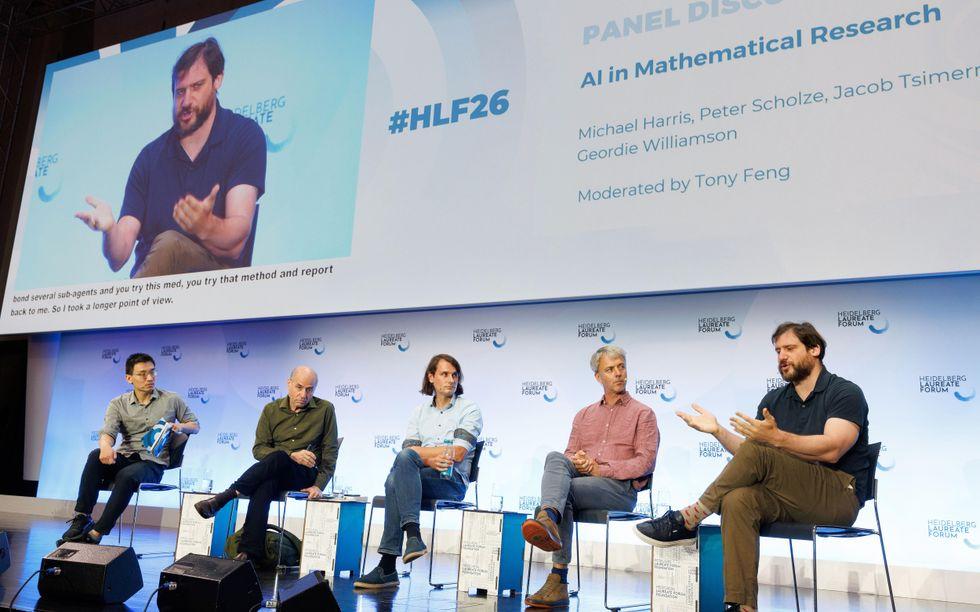
The tech giants are likely focusing on the Millennium Problems as a way of verifying the capabilities of their advanced AI systems, with the added bonus that solving these famous unsolved problems shows potential users and investors how powerful their technology is. "They’re really just solving these difficult mathematical problems as benchmarks, as some kind of PR stunt," opined Fields Medalist Peter Scholze (University of Bonn, Germany), during a panel discussion at the event about AI in mathematical research.
Why OpenAI’s Navier–Stokes solution became a controversyAlongside Scholze and Tsimerman at the panel discussion were thought-leading mathematicians Michael Harris (Columbia University, USA) and Geordie Williamson (University of Sydney, Australia). For them, these and many more problems researchers are now facing stem from the way in which tech giants fail to adhere to the norms and values deeply instilled in the mathematics community. And this was perfectly exemplified by OpenAI’s Navier–Stokes announcement.
"I think that OpenAI behaved extremely poorly, and that we should acknowledge that in the community," said Williamson. Harris had a front-row seat to this alleged poor behavior, receiving what mathematician Tristan Buckmaster (New York University, USA)—who was making significant progress with Levent Alpöge of Anthropic on the Navier–Stokes existence and smoothness problem—claimed was correspondence between him and OpenAI that appeared coercive, censorious, and even threatening.
"I trusted Tristan’s account of this interaction,… and I guess I did my part in promoting his narrative," Harris said. "But… on social media and traditional media, most reports are consistent with my takeaway; that is, they depict OpenAI as bullying and disrupting disciplinary norms." OpenAI did not respond to requests for comment prior to publication.
Beyond OpenAI’s sportsmanship (or lack thereof), Williamson is concerned about what AI’s march across mathematics this summer does to the field, both for working mathematicians and for the knowledge that can become useful to the broader society.
"What we want as a mathematical community is understanding, but we measure this against unsolved problems, and the problem is that these two measurements are very, very quickly becoming uncorrelated," he explained, referring to how AI solutions might give an answer but usually don’t develop new methodology that is understandable or useful. "So now,… we suddenly must re-evaluate things like how we assess people, who gets jobs, how do we educate people, etc. This is going to be a big challenge."
Academia under pressureWhile the tech giants tear up the rule book in their battle for supremacy, it is ordinary human mathematicians that are bearing the consequences. Unbridled access to powerful AI technologies is affecting how mathematicians work across the world.
Young mathematician Mita Ramabulana (University of Cape Town, South Africa) is a case in point. He said that two of the 10 advances in mathematics that OpenAI announced in August overlapped with his own work, but left him disappointed "because you spend some time thinking about these things, and these days you don’t know whether someone is just going to plug in a problem that you care about in some LLM and solve it." He worries that unscrupulous researchers are using LLMs to scoop others or gain professional advantage.
For Robertson, currently studying for a PhD in quantum-safe cryptography, the problem is even more acute. She has seen all of her mathematics colleagues turn to using LLMs intensively in their research, with many maxing out their Pro subscriptions, and some even spending thousands of Euros on additional tokens: "And these are PhD students who don’t have thousands of Euros," she added.
Robertson said that there are colleagues who feel coerced by the tech giants, with the likes of OpenAI announcing in July that it is giving away 100,000 free licenses to its frontier models for researchers in academia. And there are other colleagues who feel they simply have no choice: "If you don’t work at the rate at which you could work with LLMs then you will be behind your peers who will be applying for the same jobs as you".
This is part of the reason why Robertson’s PhD is now a lot less mathematics-heavy and focused on the societal implications of transitioning to a quantum-safe ecosystem: "Because I don’t want to be in a career where you’re verifying LLM output".
>