Walden Robotics Сотрудничает с Toyota в разработке практических Гуманоидов
Какое-то время казалось, что робототехника в целом погрязла в безумной спешке по созданию человекоподобных роботов главным образом потому, что это было очень возможно (и очень прибыльно), даже без каких-либо краткосрочных целей, которые обязательно были бы реалистичными. Некоторая часть волшебства первых двух лет "гуманоидного взрыва" сохранилась, но также произошло отрезвление в масштабах всей отрасли, что привело к возникновению острых вопросов о практичности и ценности. Другими словами, создание коммерческой гуманоидной компании сейчас - это совсем другое дело, чем было бы всего несколько лет назад.
15 июля компания Walden Robotics вышла на рынок stealth с объемом финансирования в 300 миллионов долларов США при оценке в 1,1 миллиарда долларов. Walden является дочерним предприятием исследовательского института Toyota Research Institute (TRI), и последние 10 или около того лет компания работала над сложными проблемами в области робототехники с целью перехода от научных исследований к практическому применению. По-видимому, именно столько времени и опыта может потребоваться для разработки практичного и ориентированного на ценности подхода к внедрению человекоподобных роботов общего назначения, и Walden выбрала отличную отправную точку, отказавшись от всего остального.
"Это иронично", - говорит соучредитель и генеральный директор Walden Расс Тедрейк. "Я думал о ногах в течение 20 лет; это предмет, который я преподаю в Массачусетском технологическом институте. Есть много причин создать робота с ногами. Но вопрос в том, на какой рынок можно ориентироваться? И какой процент его занимает колесная база?" Именно это целенаправленное, практичное мышление несколько отличает Walden от многих (если не большинства) других компаний в этой области. Вместо того, чтобы сначала разрабатывать робота, а затем искать жизнеспособный вариант коммерческого использования, Walden определила области применения, в которых роботы могут принести пользу уже сейчас, и разработала робота, который мог бы безопасно и эффективно удовлетворять эти потребности.
Walden Robotics
Компания Walden Robotics специализируется на производстве.Расс Тедрейк - генеральный директор и соучредитель Walden Robotics.Walden Robotics
Тедрейк не вдается в подробности о том, на какие конкретные приложения нацелена Walden на данный момент (ссылаясь на конфиденциальность с текущими коммерческими партнерами). Производственные и логистические среды, где существует множествоrelatively simple and repetitive tasks that aren’t friendly to conveyor belts and preprogrammed robot arms are a good bet. Even in these environments, however, robots still have to find a useful niche because they’re going up against human workers who are more flexible while also cheaper to employ. So the question is: How do you make an argument to a customer that a robot is actually a better solution than their existing human workers?
"You need to find applications with high utilization—where the robot is used 24 hours a day, 7 days a week," says Tedrake. "Manufacturing is a global imperative right now, and it makes the economics work." Economic viability is a necessary condition, but it’s not a sufficient one for Walden, or for their partnership with Toyota. People are a big part of Walden’s plan, too.
One of Walden’s major strengths is the company’s partnership with Toyota, which is not all that surprising given that Walden is a spinout from TRI, which is Toyota’s Silicon Valley–based R&D arm. "Toyota was very proud of the work we had done at TRI, and was ready to go big in this space," says Tedrake. "Part of the excitement of having Toyota as a partner is that their culture is deeply people-first. When talking to Toyota’s leadership, I was never asked how much money this is going to make, but I was asked how it will improve the quality of life for all people."
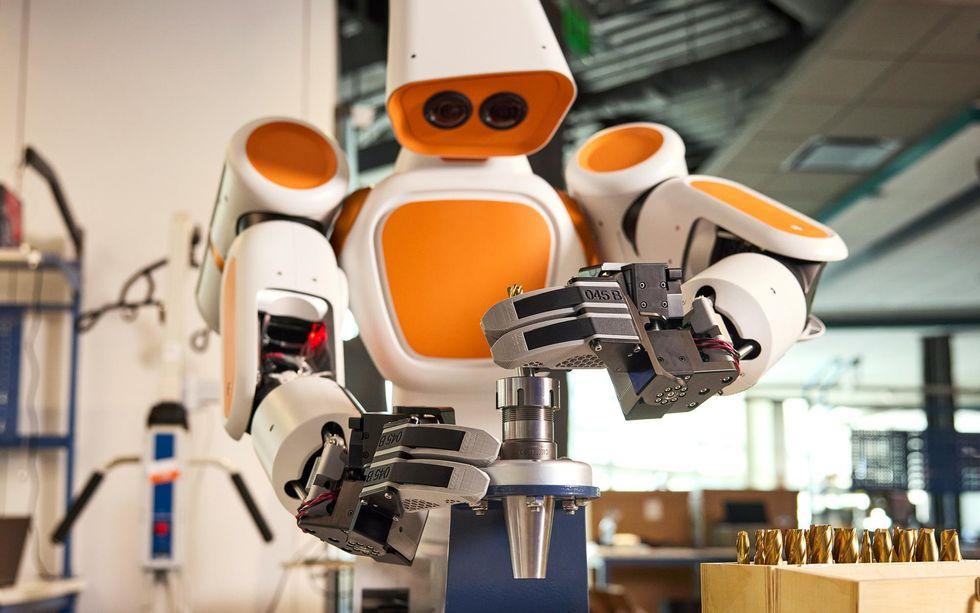
The robot’s chonky design allows it to meet the high-payload requirements of useful manufacturing work.Walden Robotics
In this context, at least in the short term, Walden’s approach to improving the quality of life for people is to take over those aforementioned repetitive manufacturing tasks with robots. Tedrake hopes that this will lead to workplaces where skilled craftspeople are able to do even more with their hard-earned expertise, increasing their efficiency, productivity, and happiness all at the same time—a noble goal, although there’s only so much Walden itself can do to make this happen, and not all customers will share Toyota’s priorities.
Wheeled Humanoid Robots in FactoriesMany other humanoid robotics companies are also targeting these logistics and manufacturing spaces with general-purpose robots, and they’re doing so by making robots that are as humanlike as possible. The theory is that a humanoid form factor is necessary when operating in human environments. And there are certainly arguments in favor of a humanoid with legs—stairs exist, for one, and legged robots have a smaller footprint compared with ones that have wheels.
But a large wheeled base offers some significant advantages, as Tedrake points out. You’re incentivized to cram the base full of batteries, since more weight near the floor keeps the robot stable, which also solves the problem of running out of power during the middle of the workday. More importantly, a statically stable robot that moves around on a wheeled base can bypass the safety challenges that are currently keeping legged humanoids physically separated from real humans—most prominently, the fact that legged robots can fall over. "Factories already have autonomous mobile [wheeled] robots," explains Tedrake. "They already have safety cases built around AMRs. You can piggyback on that with a wheeled base."
Simple, rugged grippers make the robot suitable for commercial deployment.Walden Robotics
Walden’s perspective on manipulation is similar. Many humanoid companies are using five-fingered hands that are highly dexterous but also highly complex, which Tedrake believes is not a pragmatic approach in the context of commercial deployments. "There’s a question of what you need to do the tasks, but the real question is just durability," Tedrake says. "We have been deployed in a Toyota factory, and at the end of the week, the hands take a beating, so we built hands that can take that. I have not seen a more dexterous hand that could have done the work our hand has done."
Walden’s long-term plan is to build "general-purpose robots." It’s not always clear what a general-purpose robot is, because (I would argue) nobody is quite sure what "general purpose" means. It’s certainly not referring to robots that can do everything; I think the closest we can get are robots that can be taught to do a useful number of different skills, which is why I prefer the term "multipurpose." It’s a little pedantic, I know, but I think the distinction is important because it moderates expectations in the near term.
Part of where Walden’s optimism towards general purposeness comes from is TRI’s earlier research on diffusion policy, which helps robots learn new skills more quickly by leveraging previously learned skills as a foundation. "Fundamentally, multitasking is a way to get to a general-purpose robot," Tedrake says. "I believe there is a single platform that can do a lot of tasks that are of high value for real customers. That will give us the experience we need to give birth to this deployed general-purpose capability."
>