Agentic AI превращает простой язык в самонаводящееся рентгеновское сканирование микроэлектроники
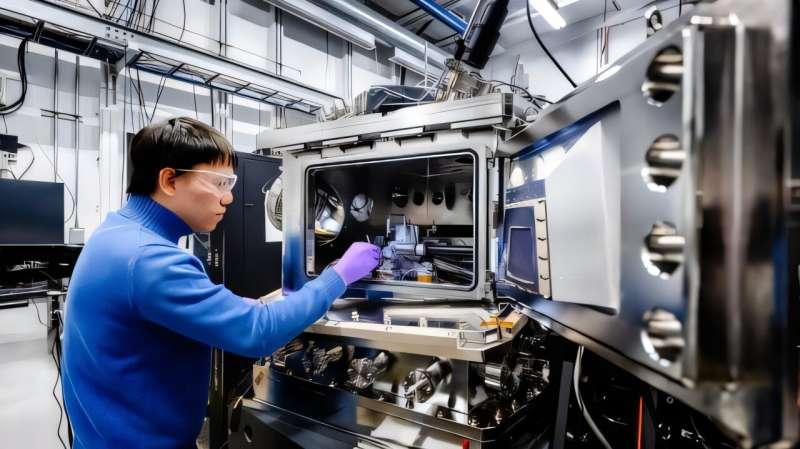
Наука все чаще использует искусственный интеллект (ИИ) в качестве своего рода микроскопа для сортировки данных, анализа изображений и выявления скрытых закономерностей. Сейчас происходит новый сдвиг: ИИ не только анализирует данные, но и помогает ученым решать, что делать дальше, с помощью простых запросов на естественном языке.
С помощью этой новой технологии — агентного ИИ — ученые могут задавать вопросы и руководить действиями на обычном языке. Затем система помогает выполнять или определять следующие шаги, превращая сложные рабочие процессы в простой диалоговый обмен с помощью чата.
В Аргоннской национальной лаборатории Министерства энергетики США (DOE) исследователи недавно продемонстрировали возможности искусственного интеллекта в рамках проекта Synergistic Neutron and Photon Science—Intelligence (SYNAPS-I), который объединяет данные нейтронных, рентгеновских и микроскопических экспериментов в национальных лабораториях в единое целое.
SYNAPS-I является частью программы Genesis Mission Министерства энергетики США, национальной инициативы по обновлению американской науки и инноваций с помощью искусственного интеллекта. Проектом руководит Национальная лаборатория Лоуренса Беркли (LBNL) Министерства энергетики США.
Первый этап SYNAPS-I показал, что ученые могут использовать тонко настроенные базовые вычислительные модели для быстрой интерпретации массивных наборов данных визуализации, полученных в ходе современных рентгеновских экспериментов. Этот этап был успешно протестирован в Аргоннском центре усовершенствованных источников фотонов (APS), Аргоннском центре лидерских технологий (ALCF), Центре наноразмерных материалов (CNM) и нескольких других учреждениях Министерства энергетики США в начале этого года.
APS, ALCF и CNM являются пользовательскими устройствами Министерства энергетики США.
Новая фаза SYNAPS-I добавляет агентный уровень искусственного интеллекта, который переносит акцент с обработки данных на управление экспериментом.
"Вместо написания кода или ввода технических команд исследователи могут общаться с искусственным интеллектом, который затем автоматически выполняет сбор, обработку и анализ данных", - сказал Минг Ду, специалист по вычислительной технике из Аргонны и член команды SYNAPS-I. - Благодаря автоматизации этих задач у исследователей появляется больше времени для того, чтобы сосредоточиться на науке и на управлении самой лучевой линией".
Проект SYNAPS-I является результатом сотрудничества национальных лабораторий Министерства энергетики США, включая Аргоннскую, LBNL, Брукхейвенскую национальную лабораторию (BNL), Национальную ускорительную лабораторию SLAC и национальную лабораторию Окриджа (ORNL).
Платформа использует передовые вычислительные ресурсы ALCF, ведущего вычислительного центра ORNL в Ок-Ридже и Национального научно-вычислительного центра энергетических исследований в LBNL, которые являются пользовательскими объектами Министерства энергетики США. Демонстрации в Аргонне проходили на рентгеновской установке, эксплуатируемой совместно APS и CNM.
Argonne advances SYNAPS-I project with agentic AIAs ultrabright X-ray beams make their way through a material, they produce millions of images in a few hours, creating huge amounts of data very quickly. In the first phase of SYNAPS-I, scientists built a real-time AI engine capable of reconstructing ptychographic images of microelectronics at the pace the data is generated. This compresses hours or days of analysis into seconds.
Ptychography is an X-ray technique that collects many overlapping diffraction patterns, the distinctive ways X-rays scatter after interacting with a material. The technique uses computation to rebuild sharp, high-resolution images.
"Real-time reconstruction changes the way experiments are performed, enabling researchers to adjust measurements on the fly instead of discovering key features they missed after the experiment has ended," said Aileen Luo, an Argonne assistant computational scientist and lead developer of the SYNAPS-I model for ptychography.
In the second phase of SYNAPS-I, agentic AI enhances this process in two major ways.
First, a natural-language interface lets scientists direct beamlines by simply describing what they want—such as "measure this region" or "map this area at high resolution"—instead of navigating complex control panels. Using those instructions, agentic AI spots important features and makes recommendations to the scientist on areas to investigate in more detail.
Second, the system automates tasks normally run by humans. One of the hardest is region-of-interest searches—finding a small feature in a potentially large sample. Because features are highly variable across samples, this task is nearly impossible to express in code.
"Agentic AI solves this by interpreting the images reconstructed in real time by PtychoFM, our ptychographic model, leveraging the vision capability of a multimodal large language model," Du said. "It works step by step: collecting the image, examining the image, deciding where to move next, refining the search and ultimately finding the target region within an image."
AI operates autonomously without human supervision for low-risk actions and asks for human approval or guidance only for operations with higher risk or uncertainty.
Once agentic AI identifies the right spot, the system automatically switches to a high-resolution scan to capture the details scientists need, said Tao Zhou, a scientist with the CNM and a member of the SYNAPS-I team.
Additionally, the team connected the agent to a powerful image-segmentation foundation model, Meta's Segment Anything Model 3 (SAM3). This allows the agent to isolate and label features within each image, adding another layer of understanding to the experiment.
The ALCF worked with the SYNAPS-I team to integrate SAM3 into the ALCF Inference Service, making SAM3 available to teams across the DOE complex. The service is a cloud-like AI platform running on Argonne's supercomputing infrastructure.
Agentic AI in actionThe SYNAPS-I team recently tested its agentic AI platform on a microelectronics sample at the 26-ID hard X-ray nanoprobe beamline shared by the CNM and APS.
Although microelectronics was chosen for the demonstration, the platform's autonomous scanning, analysis and segmentation capabilities apply to many materials, including catalysts, metals and quantum devices.
"Microelectronics was simply the example used to showcase the technology. The real achievement is developing a next-generation, AI-enhanced microscope that can benefit many scientific fields," said Mathew Cherukara, an Argonne computational scientist and leader of the Computing and AI group and the Argonne SYNAPS-I team.
Using natural language, the team instructed the AI agent to locate the interface between two regions in an integrated circuit device. AI started from a point deep inside the device. The agent scanned, analyzed, segmented and navigated through images until it found the correct region of interest.
This successful demonstration showed that the new agentic AI layer works seamlessly with the PtychoFM AI model to enable truly self-directed experimental control.
"By combining fast ptychographic reconstruction, agentic AI control and SAM3-powered image segmentation, the demonstration showed that SYNAPS-I can analyze semiconductor devices with a level of speed and consistency that traditional workflows cannot match," Zhou said.
Together, these capabilities establish a general framework for accelerating materials research across many domains.
A leap toward self-driving scienceThe SYNAPS-I team's demonstration marks a major step toward truly autonomous AI-driven laboratories, where experiments can run, adapt and interpret results with minimal human intervention.
This breakthrough advances the broader Genesis Mission to develop self-driving laboratory systems, Cherukara said.
"Combined, these SYNAPS-I advances lay the groundwork for self-driving microscopes, closed-loop experimentation and automated defect-detection tools that promise to accelerate discovery across fields ranging from semiconductor manufacturing to advanced materials and national user facilities," he said.
>