Исследователи разрабатывают двухуровневую систему искусственного интеллекта для более информативного контроля коррозии стальных мостов
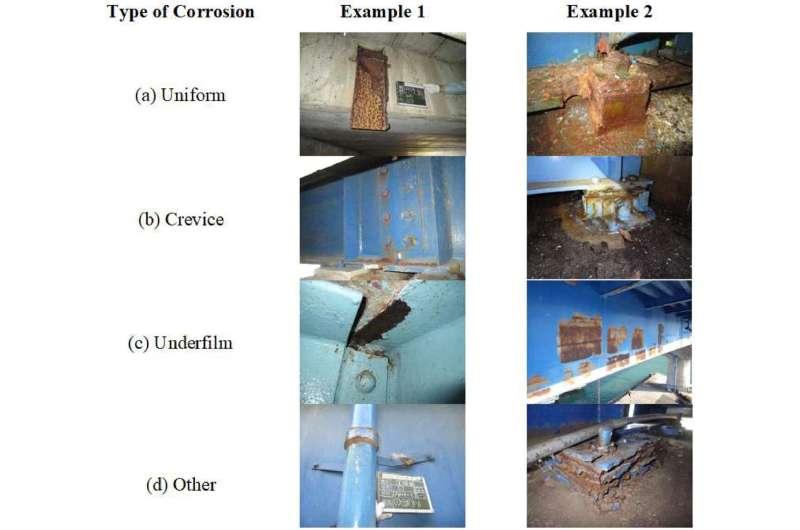
Коррозия является серьезной проблемой для стареющих стальных мостов, поскольку прогрессирующая потеря материала может повлиять на их долговечность и, в тяжелых случаях, на безопасность конструкции. Визуальный контроль по-прежнему необходим для оценки состояния моста, но инспекторы должны оценивать коррозию в самых разных условиях, включая различия в освещении, цвете покрытия, тенях, поверхностных отложениях, геометрии конструкции и доступности. Эти факторы могут затруднить последовательную оценку коррозии.
Глубокое обучение все чаще используется для автоматизации обнаружения коррозии на изображениях инфраструктуры. ""Однако большинство существующих систем рассматривают проблему как бинарную задачу: каждый пиксель классифицируется просто как "коррозия" или "фон". Хотя это полезно для определения местоположения и области коррозии, визуально различные формы износа не различаются.
Обширная коррозия на открытой стальной поверхности, коррозия, сконцентрированная вокруг стыка, и износ, связанный с разрушением покрытия, могут выглядеть по-разному и могут потребовать различных последующих наблюдений во время осмотра. Существующие подходы также основаны главным образом на измерении того, насколько хорошо прогнозируемые области коррозии совпадают с эталонными изображениями, в то время как точности определения нерегулярных границ коррозии уделяется меньше внимания.
Исследовательская группа Университета Сайтамы, состоящая из докторанта Сэла Саада Аль Дин Тахера и доцента Джи Данга с факультета гражданского строительства и охраны окружающей среды, задалась целью разработать более информативный способ отображения видимой коррозии на изображениях, полученных при осмотре стальных мостов.
Используя полевые снимки, полученные из отчетов об осмотре японских стальных мостов, исследователи создали бинарный набор данных о коррозии, содержащий 1960 изображений, и классифицированный набор данных, содержащий 1738 изображений.
Они оценили как сверточные модели глубокого обучения на основе нейронных сетей, так и модели на основе трансформаторов и представили двухуровневую структуру, в которой уровень 1 определяет наличие и пространственную протяженность видимой коррозии, в то время как уровень 2 классифицирует точки коррозии по четырем визуальным категориям, ориентированным на проверку: однородная, щелевая, под пленкой и другая локализованная коррозия.
Таким образом, команда разработала структуру, которая предоставляет дополнительную информацию о том, где происходит коррозия, какую визуальную картину она демонстрирует и насколько точно представлены ее границы.
Исследование было опубликовано в журнале Computer-Aided Civil and Infrastructure Engineering.
Key findings of the study include:- For Level 1 corrosion-coverage detection, the best-performing configuration, SegFormer-B2 with boundary-aware supervision, achieved a mean Intersection over Union (mIoU) of 84.30%, a corrosion IoU of 73.39%, and a corrosion F1 score of 84.65%. Mask2Former-Small achieved the highest Boundary-F1 score of 69.10%, showing that the model with the best overall region overlap is not necessarily the one that most accurately reproduces corrosion boundaries.
- For Level 2 visual corrosion-pattern classification, the adopted SegFormer-B5 configuration achieved a five-class mIoU of 60.45% and a mean F1 score of 67.81% across the four corrosion categories.
- The four-category visual annotation system also showed strong reproducibility. In a blinded second-annotator audit, overall agreement reached 92.81%, with a Cohen's κ of 0.892 when uncertain responses were counted as disagreements.
- Importantly, the two levels are designed to complement rather than replace one another. Level 1 provides the primary estimate of corrosion presence and coverage, while Level 2 provides supplementary information that can help inspectors decide what types of field observations and measurements should receive closer attention.
"Conventional AI-based corrosion segmentation can tell us where corrosion is visible, but inspectors often need more information than a simple yes-or-no corrosion map," Taher says.
"Our framework adds another layer of information by distinguishing visually different corrosion patterns at the pixel level. This could help connect automated image analysis more directly with the way inspectors decide where to look more closely and what should be checked in the field."
For example, a Uniform corrosion prediction can direct attention toward the overall extent of surface deterioration and remaining-thickness measurements, while a Crevice prediction can highlight joints, contact surfaces or fastener regions that warrant closer examination. Underfilm predictions can indicate areas where damaged coatings may need to be probed or inspected more closely, while Other Localized corrosion can direct attention toward localized pits, deposits, deteriorated fasteners or other concentrated deterioration.
The system is intended to guide field verification and measurement—not to make autonomous decisions about repairs, maintenance priority or structural capacity.
Looking five to 10 years ahead, the approach could become particularly useful as bridge inspection increasingly incorporates digital imaging, mobile devices, unmanned aerial vehicles and automated infrastructure-management systems.
Future studies will need to test the framework on independently collected bridge datasets, under different viewing angles, lighting conditions, image resolutions and geographical environments, as well as on mobile and edge-computing hardware. The researchers also envision combining corrosion-coverage maps and visual-category information with inspection histories, structural information and physical measurements in bridge-management systems.
"In the longer term, we hope this type of technology can become a practical assistant for engineers rather than an autonomous replacement for them," Taher says.
"If image-based corrosion information can be combined with inspection records and physical measurements, inspectors could review bridge conditions in a more systematic and traceable way. That could help infrastructure owners make better use of inspection data and focus engineering attention where it is most needed."
The researchers emphasize that the present framework evaluates visible corrosion appearances rather than directly measuring section loss, residual load-carrying capacity, deterioration rate or maintenance priority. Such engineering decisions will continue to require physical measurements, inspection records and expert judgment.
>