Контроль Китая над эрбием и иттрием может привести к замедлению роста центров обработки данных
Существует 17 редкоземельных элементов. Хотя почти все они имеют важное промышленное применение, вас могут простить за то, что вы, основываясь на новостях, полагаете, что только четыре из них имеют значение: неодим, празеодим, диспрозий и тербий.
Безусловно, это основные компоненты мощных двигателей с постоянными магнитами, которые используются в электромобилях, системах отопления и охлаждения, бытовой технике, инструментах, реактивных истребителях, бомбах и многих других системах. Но важность редкоземельных элементов для промышленности и национальной безопасности выходит далеко за рамки магнитов. Среди остальных 13 редкоземельных элементов есть два — эрбий и иттрий, важность которых не менее важна, и которые в ноябре этого года столкнутся с надвигающимся геополитическим дедлайном. В зависимости от того, как пройдут переговоры, перенос сроков может подорвать национальную безопасность США или изменить торговые отношения между США и Китаем.
Эрбий используется в усилителях, которые усиливают оптические сигналы в волоконно-оптических кабелях, пересекающих планету. Иттрий является ключевым компонентом термозащитных покрытий, которые защищают лопатки турбин и другие конструкции от воздействия высоких температур в реактивных двигателях и турбинах внутреннего сгорания, которые так востребованы для питания новых центров обработки данных.
Иттрий используется более широко, чем эрбий; помимо термозащитных покрытий, он также используется в белых светодиодных лампах и дисплеях, микроволновых фильтрах и твердотельных лазерах, а также в других областях применения. Кроме того, "небольшие количества иттрия используются в триллионах многослойных керамических конденсаторов, которые поддерживают работу нашей электроники, включая центры обработки данных с искусственным интеллектом", - отмечает Томас Круммер, консультант по редкоземельным элементам из Сингапура.
Эрбий и иттрий, пишет Круммер в электронном письме, являются хорошими примерами того, как "крошечные количества редкоземельных элементов могут оказывать огромное влияние, обеспечивая основные функциональные возможности в соответствующих приложениях". Вместе взятые, все эти редкоземельные элементы "в буквальном смысле влияют практически на все, что мы можем включать и выключать".
Китайское доминирование на рынках этих двух редкоземельных элементов составляет, по сути, 100 процентов. Возьмем эрбий: "Насколько мне известно, за пределами Китая нет ни одной компании, которая производила бы оксид эрбия в промышленных масштабах", - говорит Эрик Бендер, вице-президент по стратегии и корпоративному развитию Tronox, горнодобывающей, перерабатывающей и химической компании со штаб-квартирой в Стэмфорде, штат Коннектикут. Оксид эрбия - это молекулярная форма, которая обычно производится на установках разделения и закупается промышленными потребителями этого элемента.
For yttrium, too, industrialized economies are entirely dependent on China. China mines 90 percent of the world’s yttrium, but it processes essentially all of the world’s mined ore into an industrially usable form, such as yttrium oxide.
Yttrium coatings help turbine blades in generators and jet engines survive the heat. Sergii Zhmurchak/iStock
China’s Monopoly and the Yttrium-Erbium Supply SqueezeTwelve rare earth elements, including erbium and yttrium, are subject to global export restrictions instituted by China in April and October, 2025. The restrictions for some of them, including erbium but not yttrium, were suspended for one year in November, 2025. Exports of yttrium, and a few other rare earths, have become erratic and sharply reduced. In March, 2026, China approved a single, 60-tonne shipment of yttrium oxide to the United States, followed by a 10-tonne shipment in April. But overall, shipments of yttrium to the U.S. are down around 75 percent this year in comparison with 2025.
In November, China is expected to either extend or remove the suspensions for some or all of the 12 rare earths currently under export controls. And yet there is little movement apparent on the part of U.S. and European governments to cope with the possible cutoff of yttrium and erbium supplies. "Very few folks outside of China are talking yet about, ‘how do we produce erbium, how do we produce yttrium?,’" says Gareth Hatch, managing director of Strategic Minerals Advisory Ltd. "We’re lagging behind the geopolitics, the realities, of the day."
The most important thermal barrier coating is yttria-stabilized zirconia. GE Vernova is one of the world’s largest manufacturers of turbines and a major user of the compound. At an investor day meeting last December, GE Vernova’s CEO, Scott Strazik, said the company had enough yttrium to last into 2026, but did not specify how far into 2026. An emailed request for elaboration, sent to GE Vernova’s media organization, did not elicit a response by press time.
Nevertheless, there are clear signs that the reduced availability of yttrium is having an effect on the industry. Oerlikon Metco is one of the largest of the small group of companies that produce yttria-stabilized zirconia and the equipment that applies it to the blades and other parts of jet-engine and combustion turbines. The erratic availability of yttrium has "thrown us upside down in the last year or less," says Riston Rocchio-Heller, an engineer and lab manager at the company. Demand for combustion turbines in the United States is now at an all-time high, driven mainly by the need to power new data centers, including huge "hyperscale" facilities for AI training and inference and general cloud computing.
Yttria-stabilized zirconia is a ceramic produced by mixing yttrium oxide with zirconium dioxide. Alternatives to it exist, but some unique advantages of the yttrium-containing version have made it the standard choice, according to Roccio-Heller. Researchers are trying to find better alternatives, Roccio-Heller says: "A lot of collaborative work is going on right now," he reports. But it’s unlikely to come to fruition soon.
The erbium market is dominated by just a couple of applications: the coloring of consumer glass and erbium-doped fiber amplifiers. These amplifiers are spaced along long-haul fiber-optic lines, typically every 80–120 kilometers on a terrestrial cable, and every 50–80 kilometers for a submarine cable.
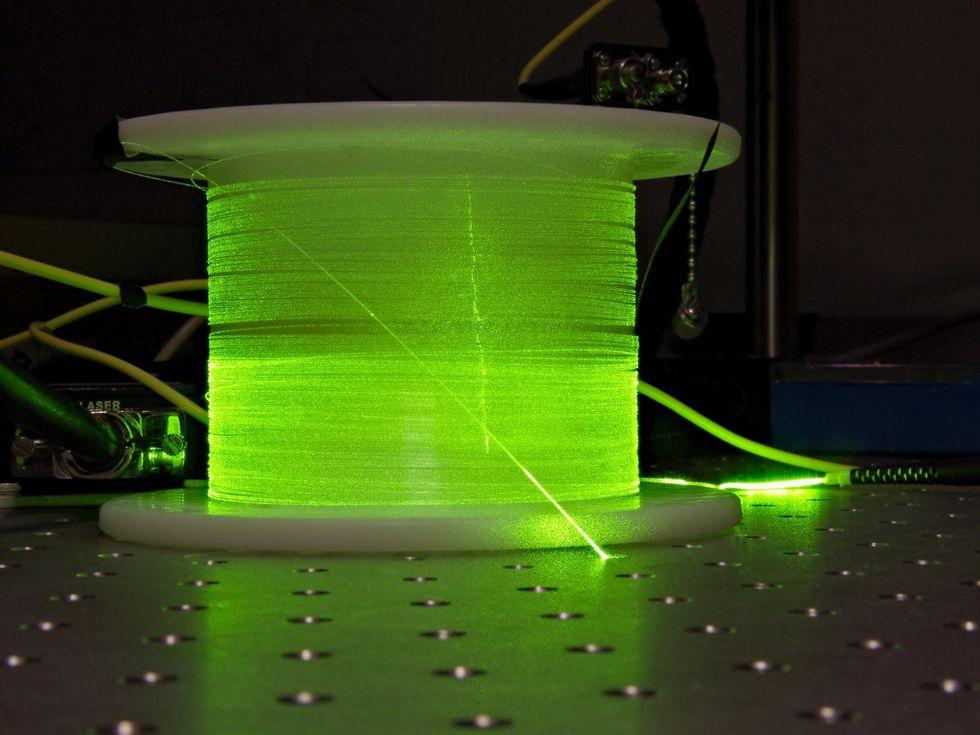
The amplifiers consist of a piece of erbium-doped optical fiber, usually between 10 and 30 meters long. The doped fiber is illuminated, or "pumped," with laser light at 980 or 1480 nanometers. That laser light excites the erbium atoms into a higher energy state. When a weak optical signal enters the length of fiber, it triggers the excited erbium atoms, which fall to lower energy states and release photons in the exact phase, direction, and wavelength—1550 nm—of the incoming signal. That wavelength corresponds to the spectral "window" in which silica optical-glass fibers cause the least loss of the signal. That’s why nothing but erbium will do here: it naturally reradiates at the necessary wavelength.
Erbium-doped amplifiers are also starting to be used in the free-space optical communication systems that connect low-earth-orbit (LEO) communications satellites, such as the Starlink satellites, with each other and with ground stations. Groups of these LEO satellites are being launched into orbit on an almost daily basis. Because their signals don’t go through glass, satellites could use a much wider variety of wavelengths. But engineers are using the erbium amplifiers anyway to take advantage of their relatively low cost and the large existing industrial base for the 1550-nm hardware, says Michel Corriveau, a researcher at MPB Communications, in Pointe Claire, Quebec, Canada, a leading provider of erbium-doped fiber amplifiers.
Corriveau says MPB obtains erbium-doped fiber for its amplifiers from a couple of companies, including Lightera (formerly OFS) in Denmark, which is now a business unit of Japan-based Furukawa Electric. An executive at Lightera, Annette Lundby, declined to comment on the company’s ability to secure stocks of erbium.
Project Vault and a geopolitical deadlineErbium, yttrium, along with 14 other rare earths and a couple of dozen critical minerals are stockpiled by the U.S. government.This National Defense Stockpile is managed by the Defense Logistics Agency, which does not comment on its specific contents. In February, 2026, the Trump administration announced a US $12 billion public-private initiative called Project Vault to stockpile rare earths and other critical materials. The funding includes $10 billion in financing from the Export-Import Bank of the United States—the largest single financing in the bank’s history.
Curtis Stough, a "defense stockpile liaison" at the Defense Logistics Agency, did not respond to a request for an interview. The U.S. Geological Survey, which tracks availability of critical minerals, also declined to make anyone available for an interview. The White House press office, too, did not make anyone available. But spokesman Kush Desai did provide a statement, which read, in part: "The Administration continues to take a multi-faceted and nimble approach to reshore critical mineral supply chains back to the United States."
That approach will surely be tested in the event that China’s 2025 export restrictions take full effect, which could happen on 10 November. But a lot will probably happen before then, says Hatch, making the outcome hard to predict. "This whole thing is ostensibly about dual-use control of materials" that have essential military uses. "But in reality, it’s part of the bigger trade picture." So Hatch expects a wider discussion, leading up to November, involving leading-edge GPU chips, extreme-ultraviolet lithographic equipment, high-bandwidth memory, design-automation software, and other tech goodies the United States and its allies are currently denying China.
>