Как автоматизация формирует будущее американского производства
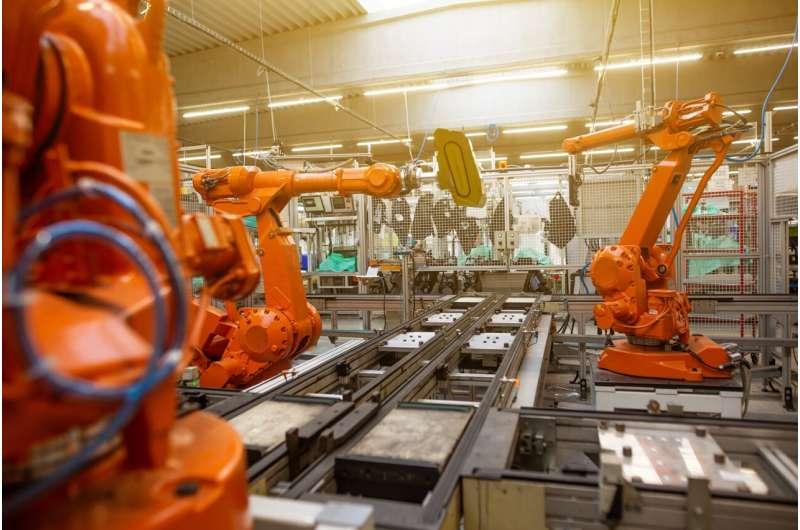
Нехватка рабочей силы, нестабильность цепочки поставок и растущий спрос на индивидуальные продукты вынуждают к фундаментальному переосмыслению методов выполнения работ на производстве в США. Чтобы оставаться конкурентоспособными, производители должны производить все более сложные детали с меньшим количеством работников, более короткими сроками выполнения и большей гибкостью, чем когда-либо прежде.
На демонстрационном производственном объекте (MDF) Министерства энергетики (DOE) в Национальной лаборатории Ок-Риджа (ORNL) исследователи решают эти задачи, разрабатывая, интегрируя и апробируя интеллектуальные системы автоматизации, адаптированные для производства с высоким содержанием компонентов и малыми объемами производства.
Вместо того чтобы конкурировать за счет затрат на рабочую силу, эти интеллектуальные, гибкие системы позволяют американским производителям выделяться благодаря своим возможностям, скорости и адаптивности. Воспринимая окружающую среду и реагируя на изменения в режиме реального времени, эти системы повышают скорость, согласованность и надежность — возможности, которые становятся все более важными в условиях сохраняющихся кадровых ограничений и усложнения производства.
В центре внимания этой работы находится Джошуа Воган, руководитель группы ORNL по робототехнике и управлению производством. Воган и его команда сосредоточены на системах автоматизации, предназначенных не для традиционного массового производства, а для гибкого, изменчивого производства, которое все больше определяет промышленный спрос в США.
В своей работе они делают упор на автоматизацию, чтобы расширить охват рабочей силы с ограниченными возможностями и сократить разрыв в производительности, который исторически ставил американских производителей в невыгодное положение на мировых рынках.
"С 2012 года производительность внутреннего производства в значительной степени стабилизировалась", - сказал Воган. "В то время, когда производительность имеет решающее значение для страны, робототехника и автоматизация являются мощным фактором увеличения рабочей силы".
Переосмысление производственной модели СШАНа протяжении десятилетий недорогостоящая рабочая сила из-за рубежа определяла глобальные производственные решения, часто выводя производство за пределы Соединенных Штатов. Этот подход был разработан для обеспечения стабильности и масштабируемости производства — условий, которые больше не определяют современный производственный ландшафт. Цепочки поставок становятся все более хрупкими, дизайн продукции все более индивидуализируется, а квалифицированную рабочую силу все труднее найти и удержать.
Традиционные системы автоматизации, предназначенные для многократного выполнения одной и той же задачи, испытывают трудности в таких условиях. Перепрограммирование оборудования для каждой новой модификации продукта замедляет производство и ограничивает гибкость, что затрудняет достижение повышения производительности, несмотря на то, что требования к скорости и индивидуализации продолжают расти.
For Vaughan, addressing these challenges requires rethinking what automation is designed to do.
"Automation isn't just about replacing labor," Vaughan said. "It's about multiplying the impact of the workforce you do have—giving people tools that make production faster and more resilient."
MDF plays a central role in advancing this new approach to automation. As a national user facility supported by DOE's Advanced Materials and Manufacturing Technologies Office (AMMTO), MDF allows researchers and industry partners to test advanced manufacturing technologies at a relevant scale, bridging the gap between laboratory innovation and factory deployment.
"At MDF, automation research is tightly integrated with additive manufacturing, materials science and advanced controls, enabling our team to examine how entire production workflows can be automated, monitored and optimized," said Ryan Dehoff, MDF director.
Advanced manufacturing technologies enabling flexible U.S. productionORNL-developed technologies demonstrate how intelligent automation can directly address today's manufacturing constraints, allowing manufacturers to do more with fewer workers while strengthening domestic supply chains.
Additively reinforced thermoforming (ART) addresses a key challenge in polymer manufacturing: producing lightweight, high-strength components without costly tooling or extensive secondary operations. ART combines additive manufacturing with thermoforming, selectively reinforcing flat thermoplastic sheets with 3D-printed patterns before forming them into three-dimensional shapes.
By eliminating metal reinforcements and reducing secondary operations, ART lowers costs, simplifies production and, when paired with in-line sensing and process monitoring, can improve quality control, making it well suited for scalable, cost-sensitive manufacturing.
Wire-arc additive manufacturing (WAAM) tackles another long-standing challenge: the domestic production of large, complex metal components. Using robotic systems enhanced with real-time sensing, data analytics and adaptive control, WAAM improves precision while reducing defects and material waste.
At MDF, researchers have advanced WAAM from a promising concept to a high-throughput production tool. Although the technology has proven effective for producing large parts in low volumes, components for energy and defense applications can be so massive that a single robotic arm would require excessive build times.
To overcome this limitation, ORNL developed MedUSA, an R&D 100 Award–winning WAAM system that coordinates three independent robotic arms equipped with welders within a shared build envelope.
Using intelligent control systems, the arms operate collaboratively without colliding, performing simultaneous deposition, in-process sensing and adaptive control. By leveraging real-time data from the weld heads, the system eliminates the need to scan each deposited bead, streamlining production without sacrificing accuracy. The result is faster deposition rates, greater geometric complexity and more efficient production of large-scale metal structures.
Building on these advanced controls, the R&D 100 Award–winning Future Foundries platform further expands WAAM's impact. The convergent manufacturing system integrates additive deposition, machining and inspection into a single automated workflow, reducing production time by up to 68%.
ORNL researcher Thomas Feldhausen said this level of integration fundamentally changes manufacturing timelines.
"By integrating additive, machining and other critical steps together into a single platform, we're reducing lead times, cutting costs and expanding what's possible for U.S. industry," said Feldhausen. "The result is a flexible manufacturing system that helps companies compete globally and strengthens domestic supply chains."
Additive manufacturing–compression molding (AMCM) is designed for speed and repeatability in composite manufacturing. By combining the benefits of additive printing with compression molding, AMCM produces finished parts in minutes rather than hours, significantly reducing labor intensity while enabling rapid design iteration.
The system uses aligned short fibers that reinforce the entire part, producing lightweight parts with much higher strength than typical 3D-printed composites made using traditional processes. This highly automated approach—recognized with an R&D 100 Award—is particularly valuable for automotive and aerospace interior applications.
Complementing this capability is ORNL's CAMX ACE Award–winning multiplexing extrusion platform, which merges multiple smaller extruders into a single high-output stream through patent-pending nozzle blocks.
The system enables multi-material printing within a single bead, including core-and-sheath structures, achieving material property combinations not previously possible. The platform expands the versatility and scalability of large-format additive manufacturing while maintaining precision and flow rate control.
Rapid RUNNERS—Rapid Research on Universal Near Net Shape Fabrication Strategies for Expedited Runner Systems—illustrates how these technologies can be applied at infrastructure scale.
The DOE-supported initiative uses near-net-shape fabrication techniques—combining additive deposition with subtractive processing—to produce large hydropower turbine runners, aiming to dramatically reduce production timelines that currently exceed one year.
"Rapid RUNNERS is laying the groundwork for a new manufacturing model for domestic production of critical energy infrastructure components," said ORNL researcher Adam Stevens.
"While the full production-scale approach has not yet been fully demonstrated, ORNL is working with industry representatives to transition this model to practice, enabling reduced lead times for key components and expanding domestic manufacturing capabilities.
"What we're demonstrating here can extend beyond hydropower to applications in the broader energy sector, national security and other large-scale industrial systems."
Intelligent automation and robotics on the U.S. factory floorBeyond individual technologies, ORNL's robotics research focuses on intelligent automation systems that reduce downtime, minimize rework and speed production changeovers. These systems sense operating conditions, make decisions and adjust operations during production, capabilities that directly address labor constraints and production variability.
Key capabilities include collision-free robotic motion planning, machine vision, digital twins for monitoring and simulation, and data-driven adaptive control. Together, these tools reduce reliance on task-specific programming and allow fewer workers to supervise multiple processes simultaneously.
Rather than fully autonomous factories, Vaughan envisions production environments where people and robots work together—combining human judgment with machine precision and endurance.
Why manufacturing automation matters for U.S. competitivenessAutomation is no longer just a pathway to efficiency—it is a strategic response to fundamental shifts in manufacturing. As labor constraints persist and production demands become more complex, intelligent automation enables manufacturers to maintain productivity and flexibility while operating with leaner workforces.
This work aligns directly with DOE priorities to strengthen U.S. industrial competitiveness and enhance energy security by building a more resilient domestic manufacturing base for critical components. By accelerating the transition from research to deployment, ORNL is equipping manufacturers with practical automation tools for the factory floor.
The future of U.S. manufacturing and industrial automationThe factory of the future is not defined by fewer people, but by smarter systems that allow the workforce to do more. At MDF, those systems are already being designed, tested and demonstrated—translating research into practical automation solutions that can be deployed on factory floors today and helping reshape U.S. manufacturing for a more resilient and competitive future.
>