Человекоподобные роботы перемещаются по узким проходам и препятствиям с помощью искусственного интеллекта, контролирующего все тело
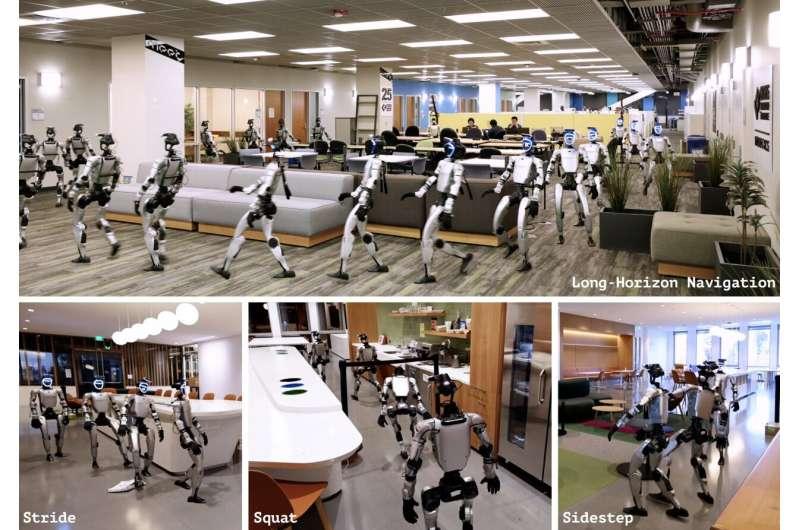
Роботы-гуманоиды, то есть роботизированные системы с телосложением, подобным человеческому, могут помогать людям в домах, офисах, медицинских учреждениях, общественных местах и в других местах. Однако, прежде чем роботы смогут эффективно функционировать в этих условиях, они должны научиться безопасно ориентироваться в перегруженной и динамичной среде.
В недавней статье, размещенной на сервере препринтов arXiv, исследователи из Калифорнийского университета в Беркли (UC Berkeley) и Принстонского университета представили TANGO - систему навигации роботов на языке искусственного интеллекта, которая может улучшить навигацию роботов в непредсказуемых условиях реального мира. Проектом руководили Анки Ли, Юйсинь Чен, Чжаобо Ли, Чжо Цао, Джунли Рен и Масаеси Томизука из Калифорнийского университета в Беркли в сотрудничестве с Дхрувом Шахом из Принстонского университета.
"Я уже много лет работаю над комплексными навигационными моделями, и почти во всех исследованиях, включая мои собственные, проблема решается как проведение линии на поверхности: двумерный маршрут из пункта А в пункт Б", - говорит Дхрув Шах, старший автор исследования. об этом сообщает Tech Xplore со ссылкой на газету. "Это разумная абстракция для робота на колесах, но гуманоид - это высокое, широкое, сочлененное тело, форма которого постоянно меняется при движении. Проходимость маршрута зависит от того, что делают руки, туловище и ноги в данный момент".
Как работает платформа TANGOПри проведении более ранних исследований Шах и его коллеги сталкивались с подобными системными сбоями. В частности, они обнаружили, что навигационная политика позволяет уверенно прокладывать путь через пробел, в который робот реально не сможет вписаться.
Таким образом, команда задалась целью разработать новую модель искусственного интеллекта, которая определяет, куда должен направляться робот, а затем предсказывает, какую форму должно иметь его тело, чтобы добраться до нужного места. Такой подход мог бы устранить недостатки различных существующих навигационных модулей, которые передают команды о скорости движения контроллерам, не имеющим информации о том, что именно робот должен был делать.
"TANGO использует инструкции на естественном языке - что—то вроде "пройди мимо ящиков на кухню" — плюс RGB-изображения, получаемые с камеры робота, расположенной как спереди, так и снизу, - и передает движения всего тела: движения всех 29 суставов гуманоида, а не команды рулевого управления," - объяснил Шах.
"It has three layers. A vision-language model interprets the scene and the instruction; a flow-matching 'action expert' generates short chunks of whole-body motion in real time; and an off-the-shelf motion tracker executes those motions on the hardware at around 200 Hz."
To train their AI model, the researchers required a large dataset containing examples of how humanoid robots can move through cluttered environments. As compiling these types of datasets in real-world settings is both challenging and time-consuming, the team instead created a dataset containing synthetic data.
"We drew inspiration from some recent work in our group on scaling up manipulation foundation models with synthetic data using an approach called MolmoBot, and found a way to do the same for humanoid navigation," said Shah.
"Our pipeline, Plan-Edit-Track, generates the data automatically in simulation: plan a safe route through a cluttered scene, edit the resulting walking motion to add the whole-body behaviors the clutter demands (tucking the arms in, crouching under an overhead obstacle, stepping over something on the floor, turning sideways for a narrow gap), then replay everything in a physics simulator and discard any motion that collides or falls over."
Using this approach, the team was able to produce roughly 65,000 verified robot trajectories for about 211 GPU-hours of computing. They then used this data to train their AI model, TANGO.
Initial demonstrations and next research stepsShah and his colleagues evaluated their framework using a photorealistic navigation benchmark that was deliberately cluttered with objects and obstacles. In addition, they deployed it on a real humanoid robot, the G1 robot developed by Unitree Robotics.
"Three things stood out," said Shah. "First, the action space matters more than we expected: when we took our own model and restricted it to predicting a flat 2D path, its success rate under real physical control fell from about 53% to about 27%. Reasoning in joint space is not a detail; it is the point."
In initial tests with the G1 robot, the TANGO framework reduced collision rates from approximately 16% to about 10% compared with the strongest modular baseline developed by the researchers. This result is even more encouraging when considering that TANGO only relies on images collected by RGB cameras, while the baseline method also used LiDAR data.
"Third, and most encouraging, our method transferred to the real robot zero-shot: the G1 walked 30-meter (98-foot) routes through a cluttered office, side-stepped through narrow passages, bent under obstacles and stepped over things on the floor, with no real-world navigation training data at all," said Shah.
"The practical implication is that a robot expected to work in a real home or office needs to treat its own body as part of the navigation problem, not as an execution detail. The encouraging part is that the data for learning this can be synthesized rather than collected by hand."
The team's data-synthesis pipeline, the dataset they compiled and the TANGO model will soon be made open source and become available online. In the future, the team plans to further refine TANGO, with the goal of enabling robots to safely interact with their surroundings in increasingly complex ways.
"The natural next step will be to go from avoiding the environment to interacting with it—opening a door, moving a chair out of the way rather than squeezing past it," added Shah. "That means pushing this from navigation toward a general loco-manipulation model. Two concrete limitations point the way: The low-level tracker is currently the bottleneck for harder terrain such as stairs, and relying purely on RGB hurts in visually ambiguous or poorly lit scenes, where depth or LiDAR should help."
© 2026 Science X Network
>