Технологический толчок ЕС стимулирует запуск сверхбыстрых лазерных установок
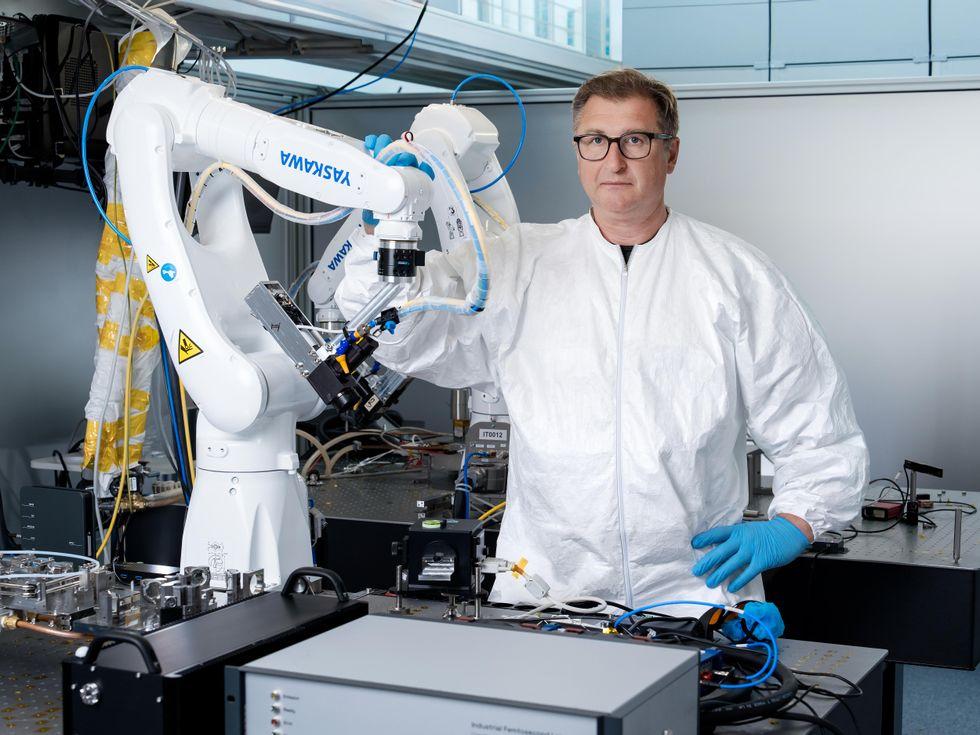
Несколько стартапов видят большие возможности для создания следующего поколения сверхбыстрых лазеров, важнейшего компонента в производстве чипов высокого класса, в Европе. В июне 2026 года Европейская комиссия предложила законодательство и стратегии, направленные на укрепление конкурентоспособности и независимости Европы в экосистемах полупроводников и искусственного интеллекта. Сейчас, в октябре, один стартап начинает строительство завода в Литве.
"Суверенитет для нас не абстрактное политическое слово — он стал причиной того, что финансирование, партнеры и внимание вообще доступны", - говорит Селия Миллон, генеральный директор Rayven Laser GmbH в Германии. "Закон о чипах 2.0", предложенный ЕС, будет поддерживать более широкую цепочку поставок компьютерных чипов, включая дизайн, материалы и технологическое оборудование, такое как сверхбыстрые лазеры. Миллон говорит, что этот сдвиг означает, что значительное государственное финансирование может достичь небольших стартапов, подобных ее.
Независимые маркетинговые исследования показывают, что мировой рынок сверхбыстрых лазеров в 2025 году составит примерно 2,4 миллиарда долларов США, увеличиваясь примерно на 20 процентов в год и достигнув более 10 миллиардов долларов к началу 2030-х годов. В нем в качестве ведущих факторов наряду с прецизионным производством и медицинским применением упоминаются миниатюризация полупроводников и усовершенствованная упаковка.
Фемтосекундные птенцыСверхбыстрые лазеры — те, которые излучают чрезвычайно короткие, от фемто- до пикосекундных, импульсы высокоэнергетического света - являются одними из наиболее ценных инструментов для продвинутой обработки материалов. Они обеспечивают высокоточную обработку, не нанося теплового ущерба окружающему материалу. Сверхбыстрая лазерная обработка необходима для создания современных компонентов микросхем, которые обеспечивают более быструю передачу данных. "Например, компоненты, называемые промежуточными соединителями — слоями проводов, которые помогают соединять сложенные в стопку чип—платы в современных полупроводниковых корпусах, - требуют крошечных отверстий, просверленных лазером, или "сквозных переходов", которые производители затем заполняют медью для прохождения электрических сигналов. "Это похоже на технологию 3D-печати, только на стекле", - говорит Николаюс Гаврилинас, генеральный директор и соучредитель литовского лазерного стартапа Litlit. Другие области применения включают в себя использование плат для зондирования печатных плат и нарезку пластин кубиками.
В октябре Litlit откроет новый завод в Вильнюсе, Литва, ориентированный на производство до 3000 фемтосекундных лазеров в год, что позволит компании выйти на лидирующие мировые производственные мощности. Когда спрос выше обычного, говорит Гаврилинас, "участники рынка ищут менее зрелые компании. Для молодых компаний, таких как Litlit, это прекрасная возможность". В то время как ученые, покупающие фемтосекундные лазеры, склонны мириться с дорогими и сложными конструкциями, промышленность нуждается в компактных и надежных лазерах, которые не требуют технического обслуживания и надежно работают в заводских условиях.
In 2014, Gavrilinas and his cofounders patented an approach for generating extremely stable one-micron-wavelength laser pulses using just a few pieces of optical fiber. Through this stable initial pulse, modulating noise becomes straightforward. The architecture achieves 20 percent electrical-to-optical efficiency, and the pure fundamental wavelength gets delivered into a high-energy beam. Over the past decade, the company developed the idea into a compact modular technology and invented sustainable production techniques. "Moving from complexity into stability is the hallmark of a mature technology," Gavrilinas says, and Litlit’s approach has reached that stage.
"We’ve been approached by companies that do things that were never on our radar." Benjamin Rudin
Millon’s company, RayVen Laser, meanwhile, has pursued another opportunity: ultrafast lasers that operate at the 2-micron wavelength, which hasn’t yet been widely commercialized. At this wavelength, Millon explains, silicon becomes far more transparent than at more traditional wavelengths. Instead of just ablating a surface, the beam can be focused and structured inside the silicon. That opens new manufacturing options for the semiconductor industry—processes that are either more efficient, require fewer steps, or simply weren’t possible before. That includes backside processing, deep-surface structuring, and through-silicon vias that allow layers in 3D chips to talk to each other. The current technology for those processes involves lots of chemicals and water. Doing it with just lasers is simpler, more cost-effective, and creates less waste material.
RayVen is currently building and qualifying its first two product lines at low-volume pilot scale, rather than mass production. Early customers and collaborators include research institutes, university labs, and industrial R&D groups that need a laser source for material-processing experiments. A new injection of EU funding in April boosted the company’s expansion deeper into the semiconductor processing world. They’re now building demonstrator systems with two partner universities.
Millon says she’s witnessed increased demand on several levels: growing interest from customers, a rising focus on this wavelength at scientific conferences, and new manufacturing needs emerging in photonic integrated circuit manufacturing and copackaged optics.
More data, more lasersOthers are more skeptical. Eric Mottay, cofounder of ultrafast laser giant Amplitude Laser in Bordeaux and now an independent consultant, doubts that Europe’s tech sovereignty campaign will have much influence on its own femtosecond laser companies. Microprocessing is an important domain in general, but it comprises many niche applications that are out of the scope for major players, he says. The telecom and datacom industries, however, have a clear market case for femtosecond lasers—and up-and-coming businesses need to demonstrate capacity for very high volumes. Mottay sees "good potential for EU companies for innovation there."
One such company is Switzerland-based Menhir Photonics. Their focus is on miniature, precision 1.5-micron-wavelength femtosecond lasers. "Our laser serves as a metronome that synchronizes telecom systems," explains Menhir CTO Benjamin Rudin. Precise synchronization among cellphone towers, for example, becomes increasingly important with the high data bandwidth in 6G systems. It’s also valuable in quantum technologies, precision microwave generation, and high-speed optical switching in AI data centers. "We’ve been approached by companies that do things that were never on our radar," Rudin says. For example, he’s working with a company that provides data center transceivers for secure transmission.
At the moment, Rudin says, no other company makes ultrafast lasers that have the same combination of specs as Menhir’s. Gain-switched laser diodes can perform a similar function in the telecom world but have worse noise performance and less bandwidth. Compared to traditional academic markets that use ultrafast lasers in quantum physics research, the datacom and telecom worlds demand maturity, reliability, and low prices. "The idea was always to miniaturize our lasers and fully automate production to address this market," he says.
Switzerland-based Menhir Photonics is automating production of miniaturized femtosecond laser units, pictured, for the telecom and datacom industry.Menhir
Motivated by growing demand for digital infrastructure, Menhir opened a state-of-the-art production facility in Zurich last August. The facility is developing fully automated assembly machines to produce few-centimeter-square laser modules. They plan to complete their first prototype by the end of 2026, scale up to full automation by the end of 2027, and produce tens of thousands of compact units per year by 2028. "This sovereignty topic is getting important. We realize just how much we rely on China," Rudin says.
Carlos Lee, director of the European Photonics Industry Consortium (EPIC), is also cautious, pointing out that "sovereignty" is a bit of a smokescreen. Even if Europe does establish semiconductor fabrication plants, it still has to purchase manufacturing equipment elsewhere—and the laser source is just a small part of these. "You’re either 100 percent independent or you’re not. If you don’t have screwdrivers to assemble the machine, you’re not independent," Lee says. But even if the EU Chips Act and its successor do not lead Europe to more independence, if they help industry, they’re great to have, Lee says: "It’s the market, not sovereignty, that are the real drivers."
>