Могут ли стартапы EDA В области Искусственного Интеллекта Стать Новым Трендом В Области Дизайна Чипов?
Полупроводниковая промышленность становится свидетелем новой битвы, поскольку искусственный интеллект трансформирует дизайн чипов, выходя за рамки традиционных инструментов EDA. В то время как представители EDA, такие как Cadence и Synopsys, внедряют искусственный интеллект, три стартапа — Agentrys, Cognichip и ChipAgents — борются за проникновение на рынок с помощью различных стратегий. Agentrys специализируется на оркестровке и корпоративном управлении, Cognichip - на базовых моделях, основанных на физике, а ChipAgents - на вертикально интегрированных платформах с собственной моделью. В центре внимания - автоматизация задач проверки, что является основным узким местом. Этот сдвиг также может предвещать появление новой модели получения дохода, основанной на проектной производительности, а не на ценообразовании за одно место, действующем сегодня.
Несколько месяцев назад я написал статью для Forbes о суперагентах Cadence Design, которые, по словам представителей компании, внедряют инструменты для разработки чипов, что позволяет ускорить процесс проектирования до 10 раз. Сейчас в игру вступили несколько стартапов EDA в области искусственного интеллекта с похожими заявлениями, и каждый из них сильно отличается. Давайте посмотрим. (Cadence Design является клиентом Cambrian-AI Research, фирмы автора).
В частности, три стартапа раскрыли подробности о финансировании и своем программном обеспечении на конференции по автоматизации проектирования (DAC): Agentrys, ChipAgents и Cognichip. Многие команды разработчиков используют комбинацию инструментов от лидеров в области автоматизации электронного проектирования (EDA), Cadence, Synopsis и Siemens, и, следовательно, платформа AI agent, которая позволяет команде координировать усилия по проектированию различных поставщиков инструментов, может оказаться привлекательной.
Стартапы EDA в области искусственного интеллекта стремятся автоматизировать разработку чиповПолупроводниковая промышленность, возможно, вступает в новый цикл разработки программного обеспечения, в котором значение смещается от оптимизации с помощью точечных инструментов к автономному выполнению рабочего процесса. Агентный ИИ для проектирования микросхем становится отличным дополнением к традиционному EDA, направленному на автоматизацию многоэтапных инженерных задач, связанных с созданием RTL, верификацией, отладкой и согласованием проектирования. И два из трех стартапов выходят на рынок с пользовательскими моделями искусственного интеллекта, которые могли бы помочь им выделиться среди крупных компаний EDA.
Проверка стала одним из самых больших узких мест в современных программах на чипах, особенно в связи с тем, что 3D-микросхемы, архитектуры на основе чиплетов и программно-определяемые системы увеличивают комбинаторную сложность проверки. Siemens называет проблему растущим разрывом в производительности верификации, в то время как в отраслевых дискуссиях агентная верификация все чаще рассматривается как уровень координации существующих потоков, а не как отдельная функция искусственного интеллекта.
Новые стартапы EDA в области искусственного интеллектаНовая группа стартаперов рассматривает эту возможность с разных сторон.
- Agentrys is building what it calls Agentic Design Automation, a platform centered on self-improving agents and agent-native toolchains for chip-design workflows.
- Cognichip is taking a model-first approach with its physics-informed Artificial Chip Intelligence platform, arguing that semiconductor design requires reasoning grounded in both logic and physical behavior rather than an agentic AI wrapper around a generic large language model.
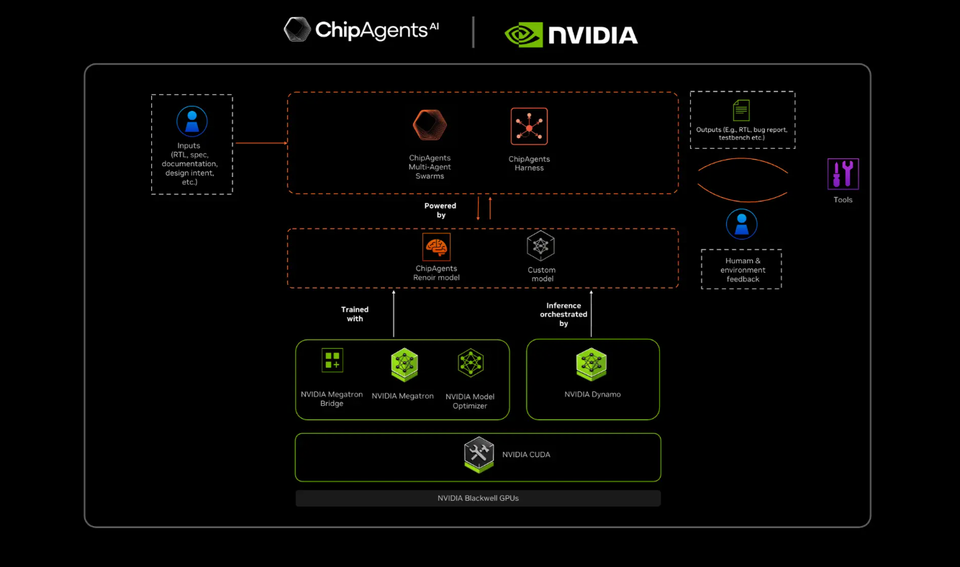
- ChipAgents, meanwhile, has evolved beyond a verification copilot story into a vertically integrated platform with workflow automation and its own fine-tuned foundation model, Renoir. The company claims to have over 120 customers on board, including some household names.
The segmentation matters because the long-term economics of the market may not resemble classic EDA seat licensing. A recent investor-oriented market analysis argued that agentic EDA may create a new revenue layer tied to verified design throughput rather than just tool access. If that view proves right, the companies with the strongest claim on workflow completion, measurable cycle-time reduction, and customer-specific feedback loops could capture disproportionate value.
So, which EDA AI Startup Will Win? "It Depends…"The near-term winners may be the companies that attack the highest-friction but most measurable tasks first. Regression triage, waveform search, assertion synthesis, testbench scaffolding, root-cause analysis, and design-spec interpretation all offer clearer ROI than a full autonomous tapeout narrative. That practical wedge explains why verification remains the most commercially attractive beachhead even for companies with much larger long-term ambitions.
The debate, then, is no longer whether AI belongs in chip design. It is where durable value will settle. If model quality dominates, Cognichip’s physics-informed approach could prove especially powerful. It is critical to realize that public RTL and verification data remain limited; much of the best training material is locked inside private design organizations, and customers increasingly want secure deployment models that keep sensitive IP behind their own firewalls. But if Cognichip can break this stranglehold, it could win big, or possibly become a takeover target. Note that Cadence purchased ChipStack last Fall to build their SuperAgents.
Although, if orchestration and enterprise control matter most, Agentrys may be well positioned. And, if vertically integrated companies that own both the workflow and the model stack deliver the best cost, accuracy, and deployment profile, ChipAgents’ positioning with Renoir becomes significantly more compelling.
And if risk management is the higher prioity, then the current EDA vendors should do very well. The incumbents are not standing still. Cadence is already positioning its agentic SuperAgents as a way to enable autonomous chip and system design workflows, and Synopsys has formalized "EDA Agentic AI" as a multi-agent approach to design automation. That incumbent push validates the market, but it also narrows the room for startups that offer only workflow layers without proprietary data, differentiated models, or deep integration into production toolchains. If the EDA leaders are already working on their own foundational models, which is likely, they still must deal with agentic AI access to other vendors’ tooling.
The TakeawayThe broader takeaway is that the next phase of competition will be defined less by demo quality and more by who can prove trusted automation inside production design teams, with measurable gains in verification throughput, engineering efficiency, and schedule compression.
Agentrys is pitching a broader agent-native design automation platform, Cognichip is positioning around a physics-informed foundation model for end-to-end chip design, and ChipAgents is more explicitly focused on RTL, verification, and root-cause analysis productivity. And the major EDA vendors have agentic platforms themselves, with the resources to help clients ensure successful adoption.
I was talking with the CEO of an AI semiconductor company the other day, and I asked him about his company’s view of agents in the design flow. I came away wondering if design teams would risk schedule by becoming distracted by a new shiny agentic product. But if that is the case, the hesitancy is unlikely to last long and the EDA AI startups have a shot. There is too much at stake to ignore the potential benefits of agentic AI and domain-specific models.
>