Неинвазивный мозговой интерфейс использует подсказки искусственного интеллекта для передачи сообщений почти в три раза быстрее
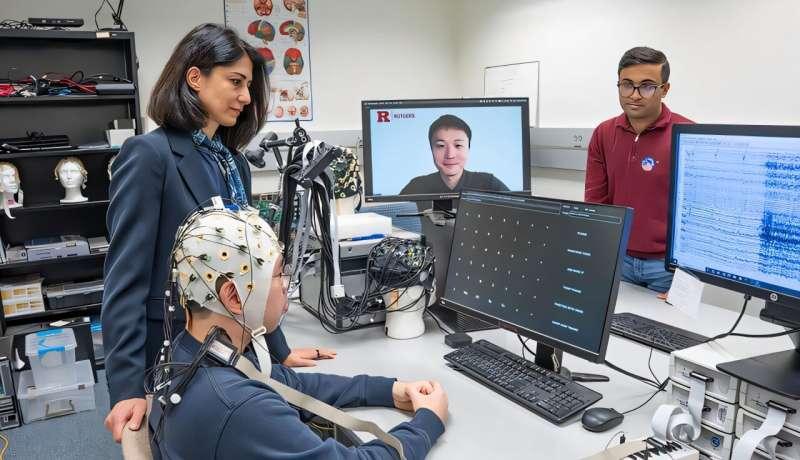
Инженеры Rutgers разработали один из самых быстрых в своем роде неинвазивных интерфейсов связи мозг-компьютер, использующий искусственный интеллект (ИИ) для преобразования мозговой активности в слова и фразы с рекордной скоростью.
Ведущий исследователь сказал, что это изобретение может значительно ускорить мозговую коммуникацию и сделать ее менее утомительной для людей с серьезными нарушениями движений и речи, в том числе с прогрессирующим БАС - прогрессирующим заболеванием, которое поражает нервные клетки, управляющие мышцами по всему телу.
По словам инженеров, система, получившая название ChatBCI-Assist, позволяет пользователям воспроизводить предложения почти в два раза быстрее, чем при обычном прогнозирующем подходе на основе словаря. Интерфейс обеспечивает коммуникацию на основе намерений, позволяя пользователям выбирать фразы, сгенерированные искусственным интеллектом, которые передают их предполагаемый смысл, без точного воспроизведения каждого слова.
Результаты исследования были опубликованы в журнале IEEE Transactions on Biomedical Engineering. Исследованием руководила Лале Наджафизаде, профессор кафедры электротехники и вычислительной техники инженерной школы Рутгерса и директор лаборатории интегрированных систем и нейровизуализации университета.
Работой руководил Вейнан Ванг, аспирант лаборатории Наджафизаде. Цзячжэнь Хонг, получивший докторскую степень в университете Рутгерса, является первым автором и выполнял эту работу вместе с Прадьюмной Рао, аспирантом той же лаборатории.
"Наша работа открывает путь к более быстрому и доступному общению с помощью неинвазивных интерфейсов мозг-компьютер", - сказал Наджафизаде.
Запланированы клинические испытания с участием пациентов с БАСИсследователи сообщили, что пока система была протестирована только на здоровых участниках. Клиническое тестирование с участием людей, страдающих боковым амиотрофическим склерозом, или БАС, находится на стадии планирования.
Наджафизаде сотрудничает с Шан Ченом, врачом-ученым и медицинским директором многопрофильной клиники ALS, в отделении неврологии медицинской школы имени Роберта Вуда Джонсона в Рутгерсе и в Университетской больнице имени Роберта Вуда Джонсона, медицинском учреждении в Барнабасе.
Together, they plan to study the system with patients and determine how it can be made more practical and comfortable.
"The rapid advances in AI technology in the health sciences are extremely exciting and offer new hope for our ALS patients," said Chen. Individuals with advanced ALS may lose the muscle control needed to speak or type.
"For many individuals with advanced ALS, cognitive abilities remain largely preserved, but progressive loss of motor control can severely limit their ability to express their thoughts," Najafizadeh said. "Traditionally, they use eye-gaze-based devices that use a specialized camera to track their eye movements to select items on the screen. These devices may become difficult to use if reliable eye control is lost."
Detecting choices, not unrestricted thoughtsBrain-computer interfaces, also known as BCIs, are designed to create a communication pathway between the brain and an external device. Noninvasive BCIs don't require surgery. Instead, the user wears a cap fitted with sensors that measure electrical activity through the scalp.
Conventional BCI spellers allow users to communicate by selecting letters one at a time to form words and sentences. ChatBCI-Assist integrates AI to enable faster communication by helping users express their intended messages without spelling out every letter.
The system doesn't read a person's unrestricted thoughts. Instead, it detects what the user is deliberately focusing on among the choices presented on a computer screen.
The screen displays a keyboard along with suggested words and phrases. Its rows and columns flash rapidly. When the row or column containing the user's intended choice flashes, the brain produces an electrical response known as the P300.
The signal gets its name because it typically appears about 300 milliseconds after a person sees a stimulus they are specifically paying attention to. A millisecond is a unit of time equaling one-thousandth of a second. Sensors in the cap detect the response, and the computer matches its timing to the flashing row and column.
That allows the system to determine which letter, word or phrase the user intended to select. P300 spelling systems have existed for decades, but they can be slow. For example, to write "I want water," a user might have to select every letter individually.
AI suggestions prioritize intended meaningChatBCI-Assist speeds the process in several ways. It incorporates a large language model, the same general type of AI used in chatbots, to predict contextually relevant words and phrases. The researchers adjusted an existing model using examples of communication messages reflecting the needs of people with ALS. Based on the user's selections and the ongoing conversation, the AI can suggest ways to express and complete the intended message.
A person attempting to communicate "I want water" might instead select an AI-generated suggestion such as "Give me water." The wording is different, but the intended meaning is similar, allowing the user to communicate faster with less effort.
"We are advocating for a change in perspective," Najafizadeh said. "Rather than focusing on reproducing every word a person wants to type, we can now look toward assistive systems that predict what users intend to communicate and help them express it more efficiently."
The user remains in control, choosing whether to accept a suggested word or phrase or continue selecting letters. The researchers also expanded how intent-based communication with BCI spellers can be evaluated by adopting measures that go beyond conventional typing accuracy.
The language model operates locally on the computer rather than connecting to a cloud-based service such as ChatGPT. That means personal messages about a user's health, physical needs or private life don't have to be transmitted over the internet. The system can also function without a reliable internet connection.
Faster communication with less effortThe researchers tested ChatBCI-Assist in two ways. In copy spelling, participants had to reproduce a sentence exactly. In semantic spelling, they had to communicate the same meaning, allowing the AI to suggest shorter or differently worded phrases.
In copy spelling experiments, ChatBCI-Assist achieved nearly twice the communication speed of a more conventional dictionary-based predictive system. In semantic spelling, its performance reached nearly three times the communication speed of the baseline.
Participants also reported that the AI-assisted system reduced their workload and rated the intent-based mode easier to use than the dictionary-based baseline. Najafizadeh said speed and technical performance are only part of the goal: The technology must fit into patients' lives without adding more stress or discomfort.
A larger goal is to move brain-computer communication beyond selecting individual letters or words and closer to the way people naturally communicate, by expressing ideas, needs and intentions, she said.
>