Беспилотник с искусственным интеллектом опережает бывших чемпионов мира, используя одну камеру и без GPS
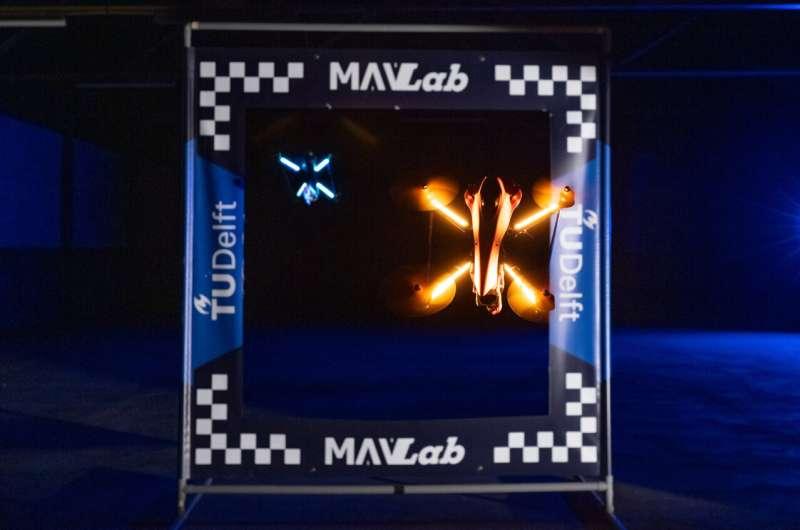
Что нужно для того, чтобы автономный робот проходил трассу быстрее, чем люди-пилоты дронов? На таких головокружительных скоростях людям нужна молниеносная реакция. Исследователи из Технологического университета Делфта (Нидерланды) разработали систему искусственного интеллекта, которая позволяет гоночному дрону преодолевать сложные трассы на предельной скорости, используя только одну камеру. Она превзошла в гонках даже бывших пилотов-дронов-чемпионов мира.
Научная работа, стоящая за этим достижением, опубликована в журнале Science Robotics и показывает, как компактное и эффективное управление на основе нейронных сетей может обеспечить высокоэффективный автономный полет в реальных условиях. Основополагающие принципы могут помочь в создании гораздо более широкого класса автономных роботов, от транспортных средств до мобильных и человекоподобных систем.
Чем меньше, тем лучшеКоманда TU Delft решила исследовать, как далеко искусственный интеллект может продвинуть беспилотник с очень ограниченными датчиками, бортовыми вычислительными мощностями и энергией. Это сложная проблема: на высокой скорости даже небольшая задержка в распознавании или управлении может привести к пропуску ворот, столкновению с препятствием или потере управления и аварии.
Результатом стала система автономного полета MonoRace, разработанная в лаборатории MAVLab факультета аэрокосмической инженерии TU Delft. В отличие от предыдущих ведущих автономных гоночных систем, MonoRace использует только одну переднюю камеру и инерциальный измерительный блок (IMU) для восприятия, навигации и управления.
Наблюдение за трассой с помощью одной камерыНа высокой скорости у дрона очень мало времени для интерпретации увиденного. Нейронная сеть распознает гоночные ворота на изображениях с камеры, в то время как встроенный IMU и модель дрона оценивают его положение и движение. Система делает все это без GPS или внешнего отслеживания движения.
"Полет на очень высокой скорости только с одной камерой является сложной задачей, поскольку изображения получаются размытыми, деформированными, а у системы искусственного интеллекта очень мало времени, чтобы точно определить, где находится беспилотник", - говорит Ставроу Банам, главный автор исследования. "Мы разработали надежный способ объединения того, что видит камера, с информацией о движении самого дрона, что позволяет ему перемещаться по трассе на высокой скорости без использования GPS". Системе также пришлось справляться с недостатками, которые возникают в реальном полете, включая помехи от камеры и насыщенность сенсоров.
Neural network takes direct controlThe researchers also redesigned how the drone is controlled. Rather than using a conventional control system with several layers of intermediate controllers, MonoRace uses a small neural network that directly generates the commands for the drone's motors.
The network runs on board a tiny computing chip, the "flight controller," giving control commands 500 times per second. It was trained using reinforcement learning, allowing it to learn how to control the drone while taking its physical limitations into account.
"Instead of first planning a desired flight path and conventional commands, our neural network learns to directly control the motors," says Robin Ferede, author of the study. "This allows the controller to react extremely quickly and exploit the capabilities of the drone while remaining small enough to run on board."
Tested under extreme conditions:To validate the system under realistic conditions, the researchers put it to the test in a demanding international competition environment. The 2025 Abu Dhabi Autonomous Drone Racing Competition provided a particularly rigorous challenge. The drone and racing environment were designed and operated by the competition organizers rather than by the Delft researchers. The system therefore had to operate successfully on both hardware and a track that the research team did not control. Despite these constraints, the TU Delft drone reached speeds of up to 100 km/h (62 miles per hour), defeating all other autonomous teams as well as three former world champion human pilots.
"Instead of giving the robot increasingly powerful sensors and computers, we wanted to find out how much intelligence we could extract from very limited resources," says Christophe De Wagter. "Drone racing provided an extreme environment in which to test these ideas outside the laboratory. It pushed us to develop AI that was not only fast but also robust and able to adapt when external reference measurements were unavailable."
Bringing AI to the real worldFor Guido de Croon, professor at Delft University of Technology, the value of drone racing goes beyond making drones fly faster. "Autonomous racing is a way of pushing robotic AI to its limits. In the current study, we made an AI efficient enough to control a drone traveling at 100 kilometers per hour (62 miles per hour) using a single camera and a small onboard processor.
"The developed AI could be applied to many more, different real-world robotic systems. Here, we optimized for speed, but the same approach could be used to prioritize efficiency or safety. For example, it could perform smooth, energy-optimal control on systems ranging from small vacuum-cleaning robots to huge ship-to-shore cranes."
The researchers believe that the same principles could help a wide range of autonomous robots make fast, reliable decisions with limited onboard resources, from vehicles and mobile robots to future aerial and humanoid systems.
>