Генеративный ИИ дает космическим кораблям автономию, которой когда-то опасались инженеры
Космос всегда считался последним рубежом освоения человеком. Похоже, что он станет последним рубежом и для искусственного интеллекта.
В декабре прошлого года Лаборатория реактивного движения НАСА использовала модели Anthropic Claude для планирования двух полетов марсохода Perseverance на Марс, при этом специалисты-проектировщики проверяли и корректировали маршрут перед загрузкой. В мае НАСА и IBM установили сжатую модель искусственного интеллекта на Международную космическую станцию и спутник для определения таких явлений, как наводнения и облака с орбиты, - это была первая модель такого рода, продемонстрированная в космосе. А в июле астронавты на МКС протестировали большую языковую модель, чтобы выяснить, может ли она помочь с вопросами о процедурах технического обслуживания.
Эти эксперименты указывают на более масштабный сдвиг в космической инженерии. На протяжении десятилетий инженеры на Земле определяли, что будет делать машина в космосе, и машина будет делать именно это. Сейчас исследователи проверяют, могут ли недетерминированные системы, такие как генеративный ИИ, дать космическим аппаратам больше гибкости в интерпретации окружающей обстановки, планировании задач и в один прекрасный день самостоятельном принятии решений. Технология все еще недостаточно надежна для передачи управления космическим аппаратом, но инженеры начинают задаваться вопросом, могут ли они позволить себе не делать этого, поскольку миссии становятся все более сложными, удаленными и многочисленными.
Почему космическим аппаратам нужна настоящая автономияКосмические аппараты работают автономно на протяжении десятилетий. Но автономия никогда не была доминирующей моделью, отчасти потому, что космические инженеры ценили системы, поведение которых они могли предсказать.
"Автономность часто не имеет детерминированного результата, а это означает, что то, как вы попали в определенную ситуацию, меняет поведение", - говорит Роберт Эмброуз, бывший руководитель отдела программного обеспечения, робототехники и моделирования НАСА. "Так что, если вы окажетесь в одной и той же ситуации, но пойдете разными путями, результат может быть разным. И поэтому инженеры это ненавидят".
Эмброуз провел большую часть своей карьеры, работая над автономными системами в НАСА, включая автономию космического корабля Orion, космического аппарата НАСА deep space и lunar orbiter, а также робота-гуманоида Robonaut 2, предназначенного для работы вместе с астронавтами, которые отправились в космос в 2011 году. На примере Orion он увидел, как быстро могут увеличиться проблемы с тестированием. Инженерам пришлось учитывать не только то, что может делать космический аппарат, но и все возможные способы принятия решения.
But Ambrose says engineers found ways to manage that complexity, including automating the testing itself. "We fought the challenges of autonomy using autonomy," he says. "That actually works."
The need for autonomy becomes even more obvious the farther a mission travels from Earth. Ambrose points to a possible mission to Europa, Jupiter’s ice-crusted moon, where a spacecraft could dive through a water plume erupting from beneath the surface. The plume could appear too quickly for engineers on Earth to direct the spacecraft into it.
"It’s up to the spacecraft to make a decision, and we’ll be watching what happened an hour ago," he says. A mission like that, he added, is "totally impossible" without giving the machine real autonomy.
Icarus Robotics engineers gather valuable training data for a free-flying robotic system—destined for the International Space Station—during a zero-g flight.Icarus Robotics
Adapting Robotics to Microgravity PhysicsAs AI and robotics advance on Earth, a commercial space boom is creating new opportunities to put those technologies to work in orbit. But what works on Earth does not necessarily work in space.
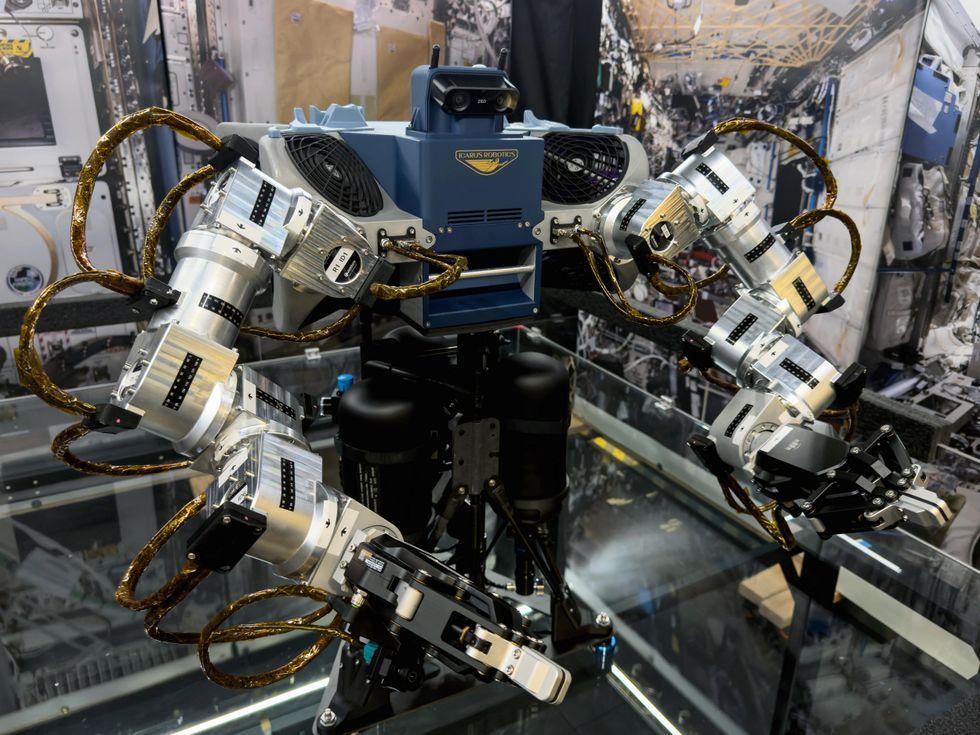
Icarus Robotics is developing what it calls a robotic labor force for space. This includes Joy, a free-flying robotic system. Joy recently finished zero-gravity testing in Canada ahead of a planned deployment to the ISS, where one of its first tasks would be moving cargo bags between modules. The company plans to start with teleoperation, using that data to eventually train the robots to work on their own.
"What the rollout will probably look like is something much closer to beginning with partial autonomy, so you still have human supervision in the loop at all times," says Jamie Palmer, Icarus’s cofounder and CTO.
A robot trained on Earth learns from the physics of the environment around it, Palmer says, and in orbit, the physics is entirely different.
"If you take the newest Gemini robotics model, or you take the newest physical intelligence model, and you put it in zero-g there, it’s just going to fail immediately," he says. On Earth, for example, a robot learns that when it pushes something off a table, the object falls. In orbit, it keeps moving.
That leaves Icarus with a problem the terrestrial robotics industry also faces, but in a more extreme form: There is very little real-world data from the environment where its robots will operate. The company is combining demonstrations from its robots in microgravity with simulations and tests on Earth to build its own dataset. "I wish there was" an available dataset Icarus could download and use, says Ethan Barajas, the company’s cofounder and CEO. "But there’s not today, not in a meaningful way."
Managing Autonomous Spacecraft RiskThe challenge is not simply teaching spacecraft to act on their own. It is figuring out how to manage the risks of giving them more freedom.
"It has been mind-boggling to me how little autonomy we have in space applications," says Ufuk Topcu, an engineering professor at the University of Texas at Austin and the director of the Center for Autonomy. "Because it’s exactly the place where human involvement is extremely hard, the stakes are high, and you need to act fast."
Topcu says that the goal cannot be to guarantee that autonomous systems will never do anything wrong. They’re most useful in situations humans cannot anticipate, he says, so instead researchers need to start with restricted applications, learn how the systems behave, and gradually expand where and how they are used. The real question, in his view, is how well the risk of deployment is managed, not whether they can be fully eliminated.
That may become increasingly important as the space industry changes. For most of the space age, a small number of government agencies designed missions that could take decades to develop and operate. Commercial companies are now putting more spacecraft into orbit, and new missions can be developed and launched much faster.
"Space used to have very slow innovation cycles," Topcu says. "They would think of a mission concept and spend 10 or 15 years on it. It’s not like that anymore. Everything is evolving faster now."
>